

A cold email is an unsolicited message sent to someone with no prior relationship. Over 91% of these messages get ignored, according to Martal Group's 2025 research. I've sent thousands of cold emails. Most got ignored. And after years of testing subject lines, personalization, and timing, I finally realized the problem was never my emails. It was who I was emailing.
I've sent thousands of cold emails. Most of them got ignored. And after years of testing subject lines, personalization, and timing, I finally realized something: the problem was never my emails.
It was who I was emailing.
Honestly? Most cold email advice is garbage. If you're hitting send on another batch of cold outreach knowing most will disappear into the void, this article is for you. I'm not going to tell you to write better subject lines or personalize harder. (That stuff barely moves the needle.) Instead, I'm going to show you why 91% of cold emails fail and what to do about it. Spoiler: it involves an 8.5x improvement in response rates.
1) The Real Reason Your Cold Emails Get Ignored
Here's the thing nobody wants to admit: the people ignoring your emails aren't being rude. They legitimately don't care. And why would they? You're a stranger asking for their time.
A cold email is an unsolicited message sent to someone with no prior relationship or engagement. According to Martal Group's 2025 research, over 91% of these emails get no reply whatsoever. Not a "no thanks." Not a "not interested." Just silence.
The fundamental flaw isn't your copy. It's targeting people based on demographics (job title, company size, industry) instead of intent. You're hoping that the right job title at the right company size equals interest in what you're selling.
It doesn't work that way.
Your perfectly crafted email is competing with 100 other perfectly crafted emails in their inbox. All from strangers. All asking for something. Sound familiar?
I remember when I was an SDR sending 80 emails a day. I'd celebrate a 3% response rate like I'd won the lottery. Looking back, I was playing a losing game. Even perfect copywriting can't overcome zero interest. It's like polishing a car with no engine. It might look great, but it's not going anywhere.
2) Cold Email Response Rates: The Numbers Paint a Grim Picture
Let me hit you with some numbers that should make any sales leader nervous.
Cold email response rates have dropped to just 1-5% according to Martal Group's 2025 data. And it's getting worse, not better. Open rates fell from 36% in 2023 to 27.7% in 2024. New Gmail and Yahoo authentication requirements are making deliverability even harder.
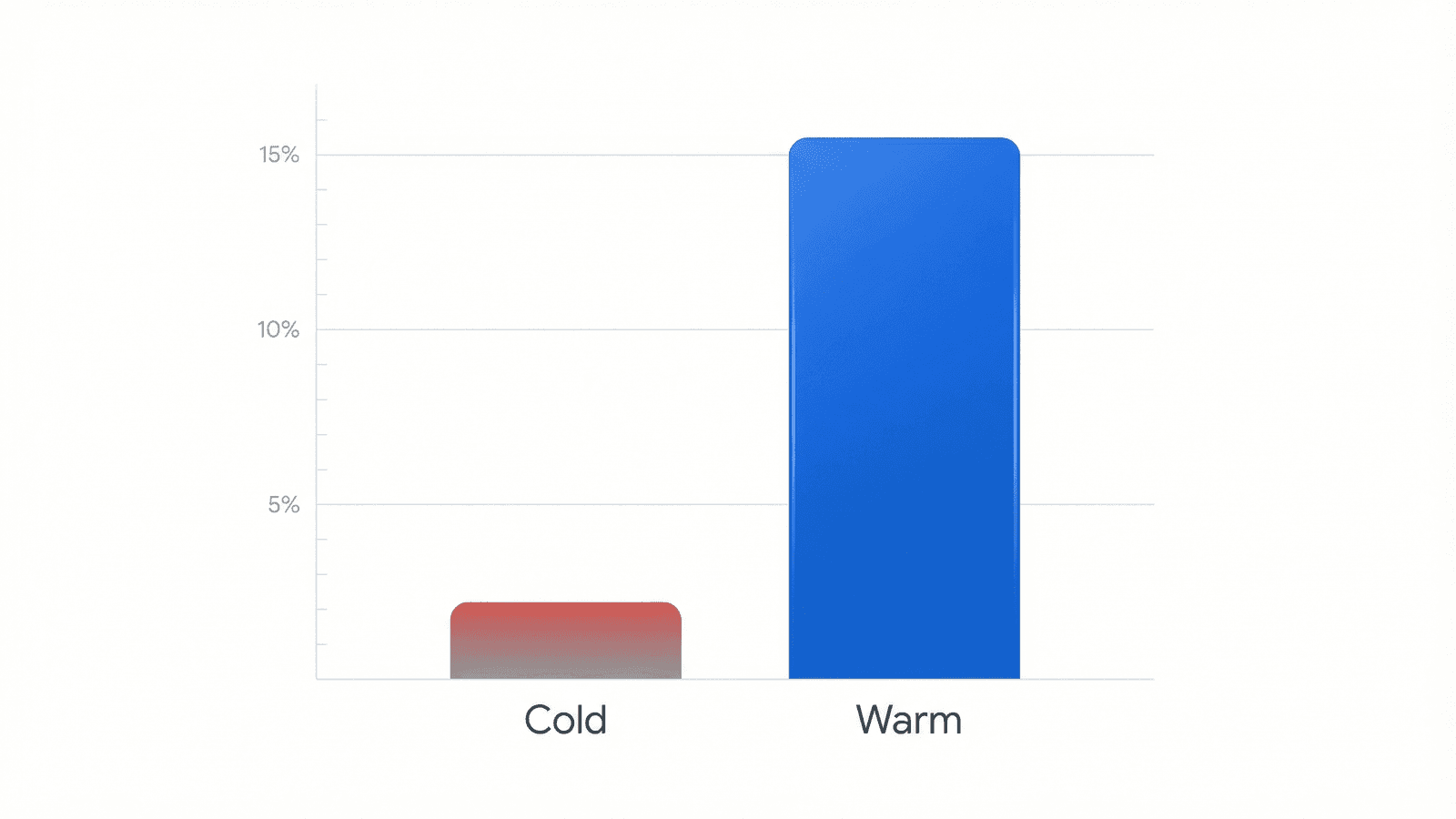
But here's where it gets interesting. Search Engine Journal research shows that warm leads convert at 14.6% compared to just 1.7% for cold leads. That's an 8.5x improvement. Not 8.5%. 8.5 times better.
A warm lead is a prospect who has already shown interest through engagement signals like comments, likes, or content consumption before you ever reach out. They've raised their hand. They've shown they care about topics related to what you sell.
LinkedIn data backs this up: 75% of B2B buyers use social media to help make buying decisions. They're out there engaging with content, commenting on posts, liking industry insights. These social engagement signals tell you exactly who's thinking about the problems you solve.
Some teams are solving this by using tools that identify intent-based leads before reaching out. Platforms like Guffles track who is liking, commenting, and engaging with relevant LinkedIn content, giving you a list of people who have already shown interest in your space.
| Metric | Cold Outreach | Warm Outreach | Source |
|---|---|---|---|
| Response rate | 1-5% | 10-15% | Martal Group 2025 |
| Conversion rate | 1.7% | 14.6% | Search Engine Journal |
| Sales cycle length | 90-180 days | 30-60 days | Guffles analysis |
| Cost efficiency | High volume required | Quality over quantity | Industry benchmark |
3) Why Fixing Your Cold Email Technique Misses the Point
I stopped believing in cold email fixes after testing 47 different subject line variations and seeing a 0.3% improvement. Seriously. Forty-seven variations for a fraction of a percent. It was exhausting.
Don't get me wrong. The tactical stuff helps a little. Belkins' 2025 research shows personalized emails get 18% response rates compared to 9% for generic messages. Follow-up emails can boost response by 49%. But here's what nobody tells you: you're still optimizing a fundamentally flawed approach.
Think about it this way. If your baseline is 2%, doubling it gets you to 4%. That's still 96% of people ignoring you. Frustrating, right? And according to Smartlead, 66% of B2B buyers expect solutions over sales pitches when contacted. They can smell a cold pitch from a mile away.
The ceiling is just too low.
I used to spend hours A/B testing send times (Thursday mornings, if you're curious). I'd obsess over personalization tokens and opening lines. All of it was rearranging deck chairs on the Titanic. The ship was still sinking because I was targeting people who didn't know me and didn't care.
The real question isn't "how do I write better cold emails?" It's "why am I emailing cold prospects at all when warm ones are right there?"

4) The Modern Alternative: Warm Signal Method for Better Response Rates
This is what I call the Warm Signal Method: finding leads who've already raised their hand through engagement (likes, comments, shares) rather than cold-targeting people who fit a demographic profile.
An intent signal is an observable action that indicates buying interest. Someone commenting on a competitor's post. Someone liking thought leadership about problems your product solves. Someone sharing an article about challenges in their industry. These actions tell you they're thinking about topics related to what you sell.
LinkedIn data shows 78% of salespeople using social selling outsell their peers who rely on cold outreach alone. And LinkedIn messages achieve a 10.3% response rate on average compared to 5.1% for cold email, according to Breakcold. That's not a minor difference. It's double.
The key is timing. I call this the 72-Hour Engagement Window. When someone engages with relevant content, you have about 72 hours to reach out while the context is fresh. After that, response rates drop back to cold levels because they've moved on mentally.
The challenge? Manually tracking LinkedIn engagement caps at maybe 5-10 posts per week. Tools like Guffles automate this process: paste a LinkedIn post URL, and it extracts everyone who engaged. Filter by your ICP criteria, and you can build a prospect list in minutes instead of hours. At $79/month, it costs a fraction of traditional sales intelligence platforms like Apollo ($300+) or ZoomInfo ($500+) that still rely on cold demographic targeting.
5) How to Make the Shift
Here's the thing: you don't need fancy tools to start. You can test this approach manually first.
Step 1: Signal Identification
Find 3-5 LinkedIn posts in your industry that got solid engagement. Look for posts about problems your product solves or competitors discussing your space. These are goldmines of interested prospects.
Step 2: Intent Validation
Go through the engagers (people who liked, commented, or shared). Check if they match your ICP: right title, right company size, right industry. Not everyone who engages is a fit. That's okay.
Step 3: Warm Outreach
Reach out within 72 hours. Reference the specific post they engaged with. Something like: "I noticed your comment on [person's] post about [topic]. Thought you might find this interesting..." You're not cold anymore. You have context.
Step 4: Measure and Iterate
Track your response rates from warm outreach versus your cold baseline. I'm willing to bet you'll see at least a 3x improvement, probably more.
The manual approach works, but it doesn't scale. You can realistically cover 5-10 posts per week by hand. That's why teams eventually look for automation. But start manual first. Prove the concept to yourself before investing in tools.
Frequently Asked Questions
Why do cold emails fail?
Cold emails fail because they target people with no prior interest. Over 91% get no reply because recipients receive too many irrelevant pitches from strangers.
What is a good cold email reply rate?
A good cold email reply rate is 5-10% in 2025. The average sits at 1-5%. Top performers achieve 10-15% by targeting prospects who have already shown interest.
Is cold email still effective in 2025?
Cold email can still work, but effectiveness has dropped significantly. Open rates fell to 27.7% and response rates sit at 1-5%. Warm outreach achieves 10-15%.
How to improve cold email response rate?
Improve response rates by personalizing beyond first names, keeping emails under 125 words, following up 2-3 times, and targeting people who have shown intent signals through engagement.
What is warm vs cold outreach?
Cold outreach contacts prospects with no prior relationship, achieving 1-5% response rates. Warm outreach contacts people who have shown interest through engagement signals, achieving 10-15%.
Warm Signal Method: Quick Start
- Find 3-5 LinkedIn posts with engagement from your target audience
- Filter engagers by ICP criteria (title, company size, industry)
- Reach out within 72 hours referencing the specific post they engaged with
Stop Sending Emails Into the Void
Look, I get it. Cold email is familiar. You've got your sequences dialed in, your templates ready to go. Switching feels risky. Scary, even.
But the numbers don't lie. 91% of cold emails get ignored. The trend is getting worse, not better. And there's an alternative that performs 8.5x better. I wasted years figuring this out. You don't have to.
Ready to stop sending emails into the void? You can start manually by tracking engagement on posts in your industry. Find the people who are already raising their hands. Or if you want to scale this approach, Guffles offers $150 in free credits to get started.
Either way, stop targeting strangers and start reaching out to people who've already shown they care. That's the real fix.
The problem with cold emails is not your copy or subject lines. It is targeting people who have no prior interest in what you offer. Target people showing intent signals for 8.5x better response rates.
Ready to Find Warm Leads?
Stop guessing who might be interested. Find prospects who have already shown buying signals through social engagement.
7-day free trial • Cancel anytime