
Every intent data comparison I've read has the same problem: it assumes you have $15K to $300K burning a hole in your pocket. "Contact sales" everywhere. Enterprise pricing hidden behind demo requests. As someone who spent 8 years building sales teams at startups, I know that's not reality for most of us.
Here's the thing. According to The Insight Collective, only 25% of B2B companies currently use intent data. That means 75% of your competitors are missing out. But I'd bet most of those 75% aren't avoiding intent data because they don't want it. They're avoiding it because they think they can't afford it.
They're wrong. And this comparison is going to prove it.
I'm giving you transparent pricing for every tool. Clear recommendations by budget tier. And I'm introducing an approach most intent data guides completely ignore: LinkedIn engagement signals as accessible first-party intent. No enterprise contracts required.
Sound familiar? You've probably searched for intent data before, seen the enterprise pricing, and closed the tab. Whether your budget is $79/month or $5,000/month, there's an intent data provider that fits. Let's find yours.
1) What Is Intent Data?
Intent data is information that reveals when a company or person is actively researching a purchase, captured through website visits, content downloads, search behavior, and social engagement.
Think of it this way. Before someone buys B2B software, they do research. According to Google research, B2B buyers conduct an average of 12 online searches before visiting a brand's website. They read comparison articles. They comment on LinkedIn posts about the problem they're trying to solve. They download whitepapers.
All of those actions leave digital breadcrumbs. Intent data captures those breadcrumbs and tells you: "Hey, this company is actively researching solutions like yours."
Why does this matter? Timing. When you reach out to someone already researching your category, you're helpful. When you cold-blast someone who's never thought about your solution, you're spam. Intent data helps you be helpful.
2) Types of Intent Data
Not all intent data is created equal. Before you compare tools, you need to understand the three main categories. This is where most guides overcomplicate things, so I'll keep it simple. (Trust me, I've waded through enough jargon-heavy whitepapers to know what doesn't help.)
First-Party Intent Data
First-party intent data is intent signals collected from properties you own, including website visits, email opens, content downloads, and social engagement on posts you can access.
Your website visits. Email opens and clicks. Content downloads. Chatbot conversations.
But here's what most teams miss: LinkedIn engagement is also first-party intent data. When someone comments on a competitor's post about a problem you solve, that's a powerful signal you can capture directly.
Companies that prioritize first-party intent data are 2.3x more likely to outperform revenue goals, according to Foundry research.
Tools like Guffles extract these engagement signals directly from LinkedIn posts, giving small teams access to first-party intent without building complex tracking infrastructure. When someone engages with content in your industry, you can capture that signal and reach out while the context is fresh. This approach to finding warm leads through social engagement is often overlooked because it doesn't fit the traditional "third-party data provider" model.
The advantage? Highest accuracy. You're capturing real engagement, not modeled behavior. The limitation? Reach is limited to people already interacting in your space.
Second-Party Intent Data
Second-party intent data comes from trusted partner platforms. Think G2, TrustRadius, Capterra. These are called "downstream intent" signals because they capture buyers actively comparing products and pricing.
Downstream intent is a type of second-party intent data from review platforms like G2 and TrustRadius, capturing signals from buyers actively comparing products and pricing.
When someone visits your G2 profile or reads reviews of competitors, that's high-intent behavior. The catch? G2 Buyer Intent starts around $40K-$50K/year. Not exactly small-team friendly.
Third-Party Intent Data
Third-party intent data is intent signals collected from external websites and platforms, aggregated by providers like Bombora who track behavior across thousands of B2B websites.
Bombora, for example, tracks 5,000+ B2B websites. When a company shows "surge" activity on topics related to your product, you get alerted. Broad reach, but you're paying for that scale. And the accuracy can vary since it's modeled behavior, not direct engagement.
| Data Type | Source | Accuracy | Reach | Cost | Best For |
|---|---|---|---|---|---|
| First-Party | Your properties + social engagement | Highest | Limited | Low | Teams with existing traffic/engagement |
| Second-Party | Partner platforms (G2, TrustRadius) | High | Medium | Medium-High | Companies in review/evaluation cycle |
| Third-Party | Aggregated web behavior (Bombora) | Medium | Highest | High | Enterprise ABM campaigns |
3) The Intent Signal Hierarchy
Not all intent signals are equal. A comment on a competitor's post shows much stronger buying intent than a passive profile view. The Intent Signal Hierarchy helps prioritize which leads to contact first.
I've seen too many teams treat all leads the same regardless of how they engaged. That's a mistake. Someone who comments "We're struggling with this exact problem" on an industry post is far more ready to buy than someone who simply viewed your company page.
Prioritize your outreach based on signal strength:
| Tier | Signal Type | Intent Strength | Example |
|---|---|---|---|
| Tier 1 | Direct Engagement | Very High | Comments on competitor/industry posts |
| Tier 2 | Content Consumption | High | Likes on problem-aware content |
| Tier 3 | Social Following | Medium | Follows industry thought leaders |
| Tier 4 | Passive Signals | Low | Views profile but no engagement |
Key takeaway: Tools that capture Tier 1 signals like direct comments and replies deliver higher-quality leads than tools tracking only passive signals like profile views.

4) Why Small Teams Need Intent Data
I hear this objection constantly: "We're too small for intent data. That's for enterprise companies with big budgets."
Actually, small teams need intent data more than enterprises do. Here's why.
When you have 3 SDRs instead of 30, you can't afford to waste time on unqualified leads. Every hour matters. Intent data helps you prioritize who to contact first.
The numbers back this up. According to DemandScience research, 99% of businesses report increased sales or ROI after implementing intent data. Gartner found that technology providers using third-party intent data are 2.09x more likely to achieve 10%+ conversion rates. And Factors.ai reports that intent-driven leads convert at 2-3x the rate of traditional leads.
But here's what really convinced me. When I was running demand gen at my last startup, we tracked buyer intent signals that indicate purchase readiness manually for three months. Exhausting? Yes. But we cut our cost per qualified lead by 50% over time. The warm vs cold outreach data tells the same story: warm leads from engagement signals close at 14.6% versus 1.7% for cold outreach. That's an 8.5x improvement.
Small teams can't afford to ignore those numbers.
5) The Pricing Problem
Let's talk about why you're probably frustrated right now.
You've searched for intent data providers before. You've seen the enterprise lists. And everywhere you looked: "Contact sales." "Request a demo." "Custom pricing." Annoying, right?
Why is it like this? Because intent data has historically been an enterprise play. Bombora built their business selling to companies with $50K+ annual budgets. 6sense targets mature ABM organizations. These tools aren't designed for 10-person sales teams.
According to WinSavvy, almost 40% of companies cite cost as the primary barrier to intent data adoption. I'd argue the actual number is higher because many people don't even investigate after seeing one or two enterprise price tags.
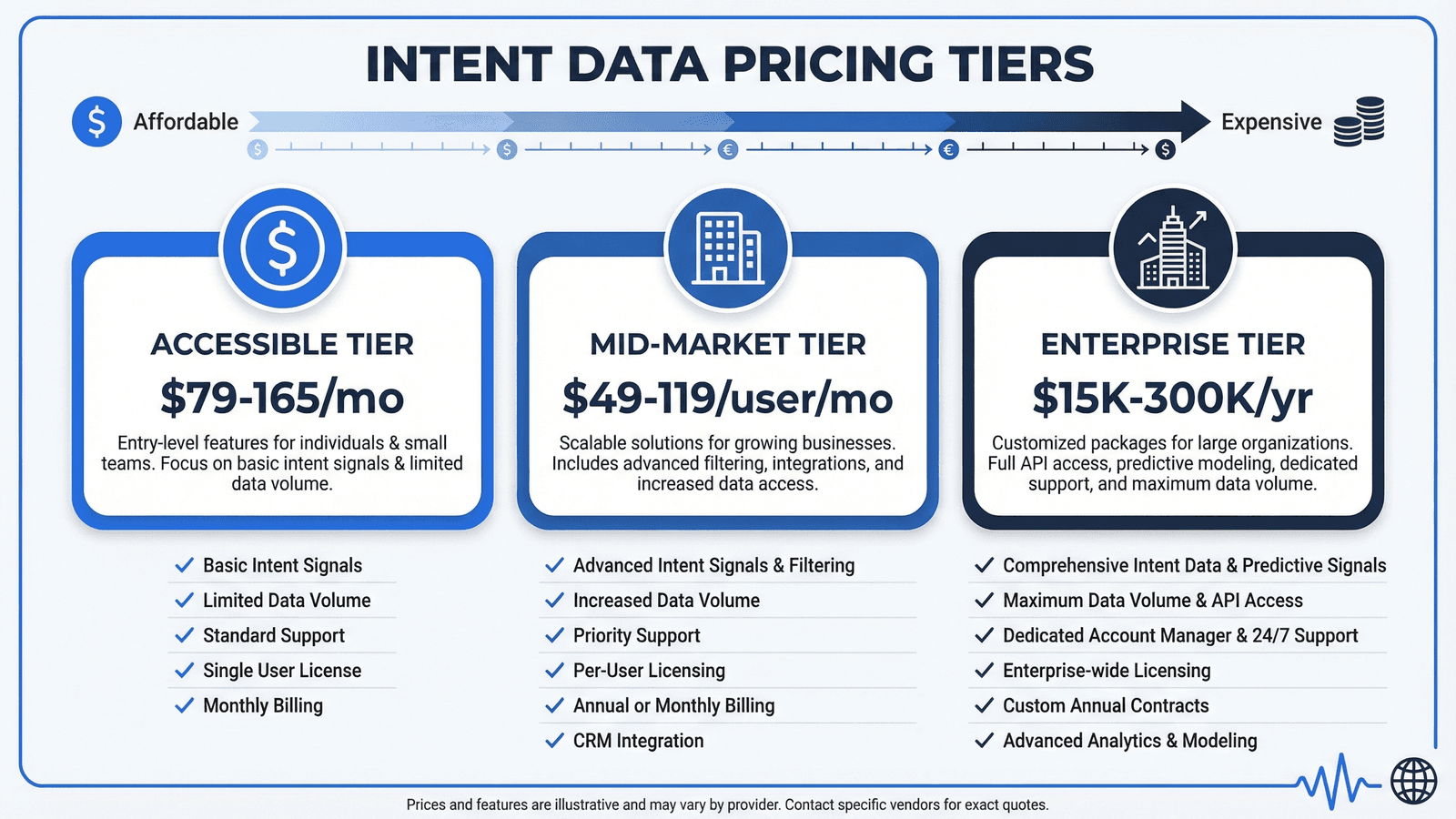
Intent data pricing ranges from $79/month for accessible tools to $300K/year for enterprise platforms. There's an option for every budget. You just need to know where to look.
That's exactly what I'm showing you next.
6) Intent Data Providers by Budget Tier
Here's the comparison you've been looking for. Every tool with actual pricing. No "contact sales" nonsense. Finally.
Enterprise Tier ($15K+/year)
Let me be direct: if your team is under 50 people, skip this tier. But you should know what's here so you understand the landscape.
Bombora: $30K-$100K+/year. Tracks 5,000+ B2B websites for topic-based intent signals. The gold standard for third-party intent, but requires dedicated ops to implement properly.
6sense: $60K-$300K/year. AI-driven predictions with ABM orchestration. Complex implementation, long contracts. Built for mature marketing organizations with big teams.
Demandbase: $18K-$100K+/year. ABM-focused platform combining intent with advertising. Enterprise marketing teams love it.
ZoomInfo: $15K-$40K+/year. 210M+ contacts with intent data in higher tiers. If you've seen those cold emails citing ZoomInfo data, this is why.
My take: These tools are powerful but overkill for small teams. The setup complexity alone requires resources most startups don't have.
Mid-Market Tier ($1K-5K/year)
Now we're getting into realistic territory for growing teams.
Apollo.io: $49-119/user/month (annual). Includes buying intent with 6-12 topics depending on plan, plus email sequences and CRM integration. Solid for SDR teams of 5-20 people. Their free tier even has limited intent data.
Cognism: $25K+/year custom pricing. Bombora intent partnership with phone-verified data. Strong in EMEA if you sell internationally. Pricing puts it at the high end of mid-market.
Lead411: $75-99/user/month. Integrates Bombora intent data with unlimited email views and growth signals. Good value for SMBs who want traditional third-party intent without enterprise pricing.
My take: Apollo is the standout here for most small teams. Per-user pricing scales reasonably, and the intent topics are included in base plans.
Accessible Tier (Under $1K/year)
This is where small teams should start. Prove the ROI of intent data before scaling up.
Guffles: $79/month with $150 wallet credits. Extracts engagement signals directly from LinkedIn posts. When someone likes or comments on a competitor's post, Guffles captures that intent signal and lets you filter by ICP criteria. It's first-party intent data without the enterprise price tag or per-user fees. Best for teams focused on LinkedIn as a lead source.
Lusha: $22-70/user/month. Contact enrichment with intent data in premium tiers. Good for individual contributors who need contact info with some intent context. The lower tiers focus more on contact data than intent.
Dealfront/Leadfeeder: $99-165/month. Website visitor identification showing which companies visit your site. Best for inbound-focused teams with existing website traffic.
My take: For teams under 10 people with budgets under $200/month, Guffles offers something different. While Lusha and Dealfront focus on contact enrichment and website visitors, Guffles captures social engagement intent. Different approach, similar price point. Start with whichever matches how you prospect.
| Provider | Pricing | Intent Type | Best For | Small Team Fit |
|---|---|---|---|---|
| Bombora | $30K-$100K+/yr | Third-party | Enterprise ABM | Poor |
| 6sense | $60K-$300K/yr | Third-party + AI | Mature ABM orgs | Poor |
| Demandbase | $18K-$100K+/yr | Third-party | Enterprise marketing | Poor |
| ZoomInfo | $15K-$40K+/yr | Third-party | Large sales teams | Fair |
| Apollo.io | $49-119/user/mo | Third-party | Growing SDR teams | Good |
| Cognism | $25K+/yr | Third-party (Bombora) | EMEA-focused teams | Fair |
| Lead411 | $75-99/user/mo | Third-party (Bombora) | SMBs wanting Bombora | Good |
| Guffles | $79/mo + $150 credits | First-party (social) | Small teams, LinkedIn focus | Excellent |
| Lusha | $22-70/user/mo | Third-party (premium) | Individual contributors | Good |
| Dealfront | $99-165/mo | First-party (website) | Inbound-focused teams | Good |
Quick Recommendation by Budget
| Your Budget | Recommended Tool | Why |
|---|---|---|
| Under $100/mo | Guffles | $79/mo, LinkedIn engagement signals, no per-user fees |
| $100-500/mo | Apollo.io or Lead411 | Broader intent topics, email sequences included |
| $500-2K/mo | Multiple seats of above | Scale team access |
| $2K+/mo | Cognism or ZoomInfo entry | Enterprise features, EMEA coverage |
Key takeaway: Small teams should start with Accessible Tier tools under $200/month, prove the ROI over 90 days, then scale up only if the numbers justify it.
7) How to Choose the Right Provider
The Social Selling Stack starts with discovery, finding who's already interested, rather than starting with a cold database and hoping for the best. But which discovery tool is right for you?
Here's my 5-step process:
Step 1: Assess your budget honestly. Under $100/month? Start with Guffles or Lusha. $100-500? Apollo or Lead411. Above that? Explore Cognism or ZoomInfo.
Step 2: Determine your data type needs. Do you need broad third-party topic signals (what Bombora provides) or is first-party engagement data (what Guffles and Dealfront offer) enough? Here's a secret: many small teams find first-party signals sufficient. You don't always need to know every website someone visits. Knowing they commented on a competitor's post is often enough.
Step 3: Check CRM integrations. Does the tool connect with your existing stack? Salesforce, HubSpot, Pipedrive? Integration complexity varies wildly. Some tools plug in with two clicks. Others need a dedicated ops person for setup. Ask me how I know. (Three failed implementations later...)
Step 4: Evaluate geographic coverage. Selling internationally? Cognism has better EMEA coverage. US-focused? Most tools work well domestically.
Step 5: Run a pilot program. Start with a 3-month test. Track leads generated, response rates, and deals closed. Calculate your actual ROI before committing to annual contracts. Most tools offer trials or money-back periods.
Don't overthink this. Pick one tool, run it for 90 days, measure results.
8) Getting Started Without Enterprise Budget
Look, I'm not going to pretend every team needs to buy software today. If you're a solo founder, you can absolutely track LinkedIn engagement manually. Find posts in your industry. Note who's commenting. Look them up. Reach out.
It works. It's just slow.
When you're ready to scale that process, here's my recommendation:
- Set baseline metrics first. What's your current response rate? Cost per lead? Close rate? You need these numbers to prove ROI.
- Start with accessible tools to prove value. No enterprise contracts. No $15K annual commitments.
- Run a 3-month pilot. Track everything.
- Measure ROI and scale if positive.
If you want to test intent-based prospecting without enterprise contracts, start accessible. Guffles offers $150 in wallet credits to explore LinkedIn engagement signals. Apollo has a free tier with limited intent data. Either lets you prove the value before scaling up.
For more options in this price range, check out our guide to the best B2B sales tools under $100/month.
The bottom line? Intent data isn't just for enterprises anymore. The tools exist for small teams. The pricing has come down. So what's stopping you? The only question is whether you'll start proving the ROI before your competitors do.
Frequently Asked Questions
What is intent data?
Intent data is information that reveals when a company is actively researching a purchase. It tracks website visits, content downloads, search queries, and social engagement to identify in-market buyers before they reach out to you.
How much does intent data cost?
Intent data costs range from $79/month (Guffles) to $300K/year (6sense). Enterprise tools like Bombora run $30K-$100K+/year. Mid-market options like Apollo cost $49-119/user/month. Small teams can start under $100/month.
What's the difference between first-party and third-party intent data?
First-party intent data comes from your own properties like website visits, emails, and social engagement. Third-party intent data is collected from external sites by providers like Bombora. First-party is more accurate; third-party offers broader reach but costs more.
Is intent data worth it for small businesses?
Yes. Intent-driven leads convert 2-3x better than traditional leads. Skip enterprise tools ($15K+/year) and start with accessible options like Guffles ($79/month) or Apollo ($49-119/user/month) to prove ROI first.
How do I choose an intent data provider?
Choose based on budget, data type (first vs third-party), CRM integrations, and geographic coverage. Run a 3-month pilot before annual contracts to measure actual ROI.
Key Takeaways
- ✓Intent data pricing spans from $79/month (Guffles, Lusha) to $300K/year (6sense), giving small teams affordable entry points that enterprise-focused guides often ignore.
- ✓LinkedIn engagement signals are first-party intent data that most teams overlook, offering the highest accuracy because you're capturing actual engagement rather than modeled behavior.
- ✓According to Factors.ai research, intent-driven leads convert at 2-3x the rate of traditional leads and cut cost per qualified lead by 50% over time.
- ✓Run a 3-month pilot with one tool in the Accessible Tier (under $200/month) to prove ROI before committing to enterprise contracts.
- ✓The best intent data tool for small teams matches your budget and workflow, not the one with the most features or highest price tag.
5-Step Provider Selection Process
- Assess your budget honestly (under $100, $100-500, or $500+)
- Determine data type needs (first-party engagement vs third-party topic signals)
- Check CRM integrations with your existing tech stack
- Evaluate geographic coverage if selling internationally
- Run a 3-month pilot and track ROI before annual contracts
Try Intent-Based Prospecting Today
You don't need an enterprise budget to start using intent data. Begin with a 3-month pilot using accessible tools, measure your results, and scale based on ROI. The data shows intent-driven leads convert 2-3x better than traditional prospecting. The only question is when you'll start.
Guffles offers $150 in wallet credits to test LinkedIn engagement signals as intent data. No annual commitment required. Prove the value before you scale.
Find Warm Leads Through Intent Signals
Stop guessing who's ready to buy. Guffles extracts engagement signals from LinkedIn posts, giving you first-party intent data without enterprise pricing. Start with $150 in credits.
7-day free trial • Cancel anytime