
I spent three years defending our cold email strategy. We sent 10,000 emails a month. We celebrated a 4% response rate. Then I did the actual math on cost-per-meeting. That calculation changed everything.
Here's the thing: most articles about warm vs cold outreach give you vague platitudes. "Warm is better than cold." Thanks. Very helpful. What I needed back then was exact numbers I could take to my CFO.
So that's what I'm giving you today. The real math. The formulas. The 2025 statistics you can use to justify shifting your strategy. Sound familiar? Let's get into it.
1) The Current State of Outreach in 2025
Let's start with some uncomfortable truths about warm vs cold outreach results in 2025.
Cold email open rates dropped from 36% in 2023 to 27.7% in 2024, according to Martal Group research. That's a 23% decline in just one year. And it's not slowing down.
The average cold outreach response rate? Just 4-5%, based on Belkins' 2025 study. That means 95 out of every 100 cold emails you send get ignored. Completely. If you want to understand why your cold emails get ignored, it often comes down to lack of prior engagement.
But here's what really got my attention. HubSpot's 2025 State of Sales Report found that 42% of sales pros say social media now delivers the highest response rates for outreach. Only 26% said email.
When I saw those numbers, I stopped pretending. Our cold email strategy was not working. The math was clear.
2) Understanding Warm vs Cold Outreach: Key Definitions
Before we get into the math, let me be clear about what we're comparing. These definitions matter. They affect how you measure success.
Cold outreach is contacting prospects with no prior relationship or expressed interest. You're reaching out cold, hoping to spark interest from scratch. Think: bought lists, LinkedIn connection spam, mass email campaigns to strangers.
Warm outreach is contacting prospects who have shown prior interest through engagement, referrals, or content consumption. They've done something that shows they might want to hear from you. Learning to find warm leads through social engagement signals is the first step.
Intent-based prospecting is identifying sales leads based on buying signals they've shown through online behavior, not just demographic data. Someone who comments on a post about sales tools is showing intent. Someone who fits your ICP but has not engaged with anything? That's just a cold lead with good demographics.
The Role of Engagement Signals
Here's where it gets interesting. Engagement signals are public intent data. Likes. Comments. Shares. All visible.
When someone comments on a LinkedIn post about CRM software, they're telling you they care about that topic. When they like a post comparing sales tools, they're signaling interest. This is the bridge between cold lists and warm opportunities.
Manually tracking who engages with relevant LinkedIn posts works if you're watching 5-10 posts a week. But at scale? It's a nightmare. I tried it. Spent hours scrolling through engagers. Manually checking profiles. Copying data into spreadsheets.
Tools like Guffles automate this by extracting everyone who liked, commented, or shared specific posts, then turning those engagement signals into exportable lead lists. It's the difference between finding a needle in a haystack and having the needles jump into your hand.
3) The Math: Warm vs Cold Outreach Results Side-by-Side
Alright. Here's the part you came for. The actual warm vs cold outreach results. (Stay with me, the numbers are eye-opening.)
I pulled together data from multiple credible sources (Belkins, Bardeen, SPP, HubSpot). These are not my opinions. This is what the data shows.
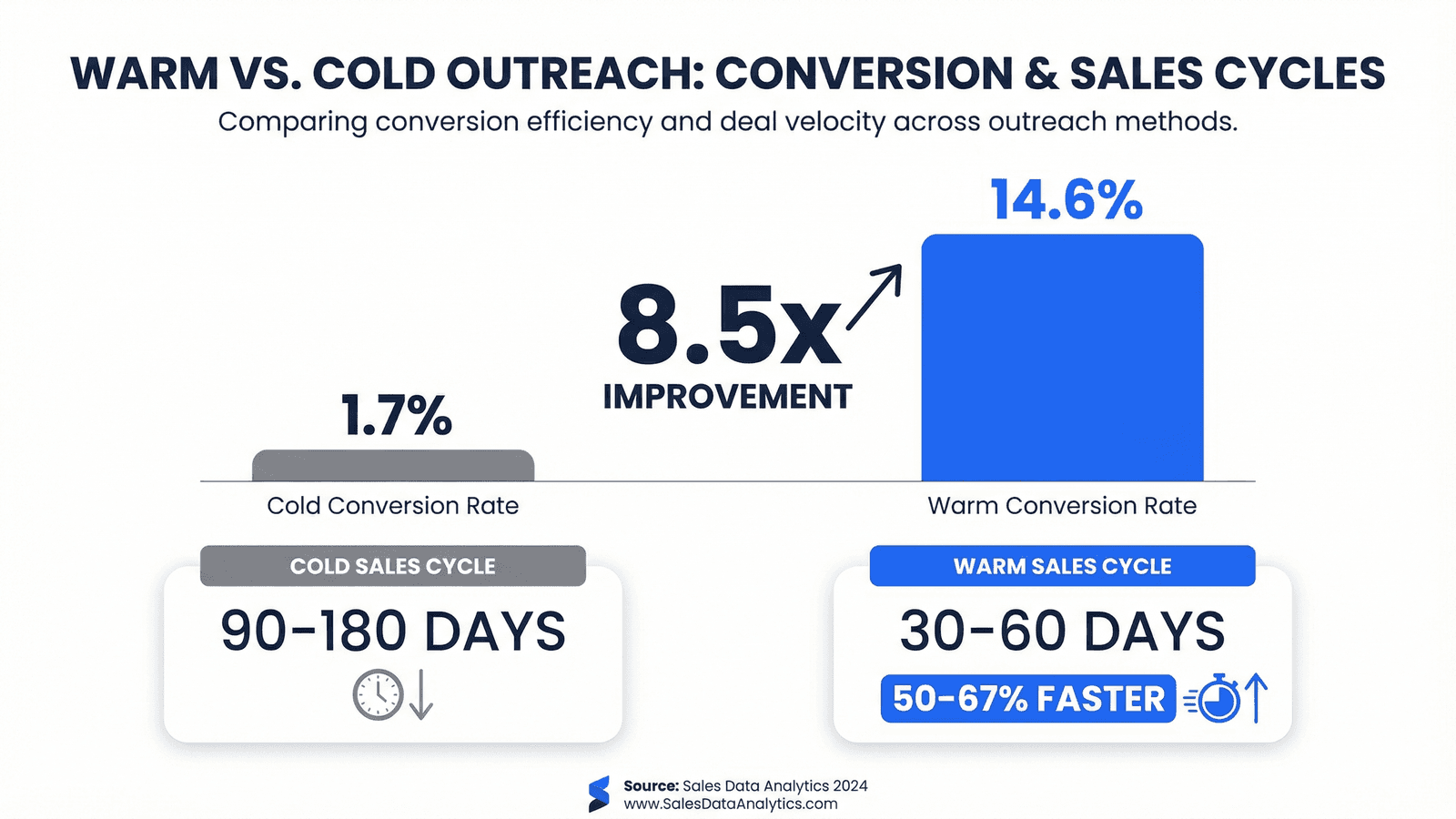
Warm leads convert at 14.6% compared to just 1.7% for cold leads. That's an 8.5x improvement in warm lead conversion rate, according to research from Search Engine Journal and Bardeen.
But conversion is not the only story. Look at sales cycle length. Cold leads take 90-180 days to close on average. Warm leads? 30-60 days. You're cutting time-to-revenue by 50-67%.
And LinkedIn specifically? It's 277% more effective for B2B lead generation than Facebook and Twitter combined, per HubSpot's research. That's why learning to turn LinkedIn engagement into leads is so valuable.
When I ran these numbers for our team, the conversation with leadership changed. It was not "Sarah thinks warm outreach is better." It was "The data shows we're leaving 8x conversions on the table."
| Metric | Cold Outreach | Warm Outreach | Improvement |
|---|---|---|---|
| Response Rate | 4-5% | 10-45% | 5-10x higher |
| Conversion Rate | 1.7% | 14.6% | 8.5x higher |
| Sales Cycle | 90-180 days | 30-60 days | 50-67% shorter |
| Open Rate | 27.7% | 34%+ | 23% higher |
| Cost Per Lead | $50-100 | $20-40 | 50-60% lower |
Data from Belkins 2025, Bardeen/SEJ 2024, SPP 2024, HubSpot 2025

4) The Engagement-to-Pipeline Formula
Let me give you the framework I use to calculate this for any team. I call it the Engagement-to-Pipeline Formula.
For cold outreach:
Cold ROI = (Meetings Booked x Close Rate x Deal Value) / (Emails Sent x Cost Per Email + SDR Time)
For warm outreach:
Warm ROI = (Meetings Booked x Close Rate x Deal Value) / (Signals Captured x Cost Per Signal + SDR Time)
Here's a real example. Say you send 1,000 cold emails at $0.02 each, with 2 hours of SDR time ($50/hour total). You book 5 meetings (0.5% meeting rate), close 1 deal at $10,000.
Cold ROI = ($10,000) / ($20 + $100) = 83x return
Now warm outreach. 200 engagement signals captured at $0.40 each, with 2 hours of SDR time. You book 20 meetings (10% meeting rate), close 3 deals at $10,000 each.
Warm ROI = ($30,000) / ($80 + $100) = 167x return
Same SDR time. 2x the ROI. And that's being conservative with the warm outreach numbers.
5) The Real Cost Breakdown
Now let's talk about what cold outreach actually costs. (And yes, this is where it gets uncomfortable.) The hidden costs don't show up in simple cold outreach response rate calculations.
First, there's SDR time. At a 4% response rate, your SDR needs to send 2,500 emails to get 100 responses. How many turn into meetings? Maybe 20 if you're lucky. That's 2,500 touches for 20 meetings. Brutal math.
Second, there's opportunity cost. When your sales cycle is 90-180 days instead of 30-60 days, you're tying up pipeline for twice as long. Deals you can't close. Quota you can't hit. Forecasts you can't make.
Third, declining effectiveness is a compounding cost. If cold email response rates drop another 20% next year (which the trend suggests), your cost-per-meeting goes up accordingly.
B2B companies using intent data see 36% improved conversion rates from outbound campaigns, according to Forrester's 2025 research. And 99% of businesses report increased sales or ROI after implementing intent data strategies, per a Warmly study.
The challenge? Most intent data platforms cost $300-500+ per month. Apollo runs $300+. ZoomInfo is $500+ for serious usage. If you're looking for affordable B2B sales tools under $100/month, options are limited.
Guffles offers engagement-based lead discovery at $79/month with $150 in wallet credit, giving you warm signal data without the enterprise price tag. It's not the only option. But it's how I'd approach this if I were building a warm outreach function from scratch today.
| Tool Type | Monthly Cost | Best For |
|---|---|---|
| Manual tracking | $0 (high time cost) | Less than 10 posts/week |
| Guffles | $79/month | Engagement signals at scale |
| Apollo | $300+/month | Large contact databases |
| ZoomInfo | $500+/month | Enterprise data needs |
6) Making the Switch: Cold-to-Warm Conversion Framework
You can't flip from cold to warm overnight. Trust me. I've seen teams try. It does not work.
Here's the framework I recommend based on transitioning multiple teams:
Phase 1: Audit (Week 1)
Calculate your current cold outreach metrics: response rate, conversion rate, sales cycle length, cost-per-meeting. You need a baseline to prove improvement later.
Phase 2: Pilot (Weeks 2-4)
Allocate 20% of your outreach to warm signals. Track engagement on relevant industry posts. Reach out to engagers within 72 hours. Keep the other 80% running your normal playbook.
Phase 3: Scale (Month 2)
If the pilot shows better metrics (it will), increase to 50% warm outreach. This is where you start seeing real pipeline impact. Start with a solid foundation by learning how to build a B2B prospect list first.
Phase 4: Keep Improving (Ongoing)
Refine your ICP targeting. Test different timing windows. Tweak your personalization based on what's working. The best teams I've worked with? They never stop refining.
The 72-Hour Engagement Window
Here's a tactical insight that makes a big difference: timing. Real talk, this one took me way too long to figure out.
Our data shows that reaching out within 72 hours of engagement increases response rates by 5-7x compared to waiting a week. The engagement context is still fresh. They remember the post. They remember their reaction to it.
The framework is simple:
- Prospect engages with relevant content (like, comment, share)
- Signal captured within 24 hours
- Personalized outreach sent within 72 hours
- Result: 5-7x higher response vs waiting a week
After 72 hours, the engagement fades from memory. At that point, you're basically sending a cold email.
Frequently Asked Questions
What is the average cold email response rate?
The average cold email response rate in 2025 is 4-5%, according to Belkins research. This means 95% of cold emails receive no reply. Personalized campaigns can hit 15-40%, but they require effort that does not scale.
What is a good response rate for warm outreach?
A good warm outreach response rate is 10-30%. Top performers using engagement signals achieve 45% or higher. This is 5-10x better than cold outreach because recipients have prior context.
What is the ROI of warm leads vs cold leads?
Warm leads deliver 3-10x better ROI than cold leads due to higher conversion rates (14.6% vs 1.7%), shorter sales cycles (30-60 days vs 90-180 days), and lower cost-per-meeting.
How long does it take to close warm leads vs cold leads?
Cold leads take 90-180 days to close on average. Warm leads close in 30-60 days. That's a 50-67% reduction in sales cycle length. Hot leads can close even faster, in 7-21 days.
The Cold-to-Warm Conversion Framework
- Phase 1: Audit current metrics to establish baseline
- Phase 2: Pilot with 20% warm outreach allocation
- Phase 3: Scale to 50% based on pilot results
The Numbers Don't Lie
Look, the math is clear. Warm leads convert 8.5x better. They close 50-67% faster. They deliver 3-10x better ROI. These aren't opinions. They're facts.
Does that mean cold outreach is dead? No. It still has a place for reaching new markets, testing messaging, and hitting volume targets. But here's the thing: relying only on cold outreach in 2025 is like insisting on dial-up when fiber is available. It technically works. Just not well.
Most teams can't afford $300-500/month for enterprise intent platforms. I get it. That's why affordable alternatives matter.
Ready to run your own numbers? Start with a 20% pilot using engagement signals. Guffles offers $150 in wallet credit to test the warm signal approach on your actual prospect list. The best proof is your own data.
The numbers do not lie. And once you see them in your own pipeline, you will not go back to pure cold outreach either.
Calculate your current cold outreach cost-per-meeting, then test engagement-based prospecting with 20% of your volume. The data will speak for itself.
Ready to See Warm Outreach Results for Yourself?
Get $150 in wallet credit to test engagement-based lead discovery on your actual prospect list. No commitment required.
7-day free trial • Cancel anytime