
I spent the first three years of my sales career convinced that better personalization was the answer to everything. If response rates were low, I just needed to research more, write smarter first lines, find more clever angles. Sound familiar?
Here's the thing nobody wants to admit: SDRs are spending more time than ever on personalization, yet response rates keep dropping. Something doesn't add up. You've been told personalization is the answer to low response rates. So you research every prospect, craft custom first lines, and still see single-digit replies. The problem isn't your effort. It's the math. (And I had to learn this the hard way.)
This guide teaches you practical tactics for scaling personalization - triggers, segmentation, the right way to use AI. But I'm also going to show you something most guides won't: even perfect personalization has a ceiling. And sometimes the smarter play isn't better emails. It's better leads.
1) Why Personalization Actually Works (The Data)
Before I get contrarian on you, let me be clear: personalization works. I've seen it. I've measured it. The data backs it up.
The Numbers That Prove It
According to Belkins' analysis of 16.5 million cold emails, average reply rates have dropped to just 5.8% in 2025 - down from 8.5% in 2019. But here's where it gets interesting. Backlinko's email outreach study found that emails with custom content see a 32.7% boost in response rates.
And if you really commit? Highly personalized campaigns using multiple custom fields boost reply rates by 142%, according to Smartlead's 2025 research. That's not a typo.
Here's the kicker though: according to Mailshake's State of Cold Email report, only 5% of senders personalize every email. Most people don't do it. But those who do? They get 2-3x better results.
Cold email personalization at scale is customizing outreach emails with recipient-specific details while sending to hundreds or thousands of prospects, using segmentation, templates, and automation.
So yes, personalization matters. The real question is: how do you actually do it at scale without burning out?
2) How to Personalize Cold Emails at Scale (4 Tactics)
Here are four tactics that let you personalize without spending 10 hours a day on research.
Tactic 1: Segment by Shared Triggers
This is the tactic that changed everything for me. Stop grouping prospects by demographics alone. Group them by signals - things that actually happened to them recently.
Common triggers include: funding rounds, job changes, hiring sprees, product launches. When you segment by trigger, you write one template that feels personal to everyone in that group.
For example, everyone who just raised a Series A has the same context: they're flush with cash, probably hiring, and looking to scale fast. One template, same relevance, fraction of the time. Game changer.
Trigger-based personalization is customizing emails based on specific prospect signals like funding announcements, job changes, or content engagement rather than generic demographic data.
Tactic 2: Personalize the First Line Only
I used to personalize everything. Every paragraph. Every sentence. I was thorough. I was also wasting my time.
Here's what I learned: the first line gets the attention. The body delivers the value prop. Research shows personalized subject lines alone boost opens by 37%, according to Experian. For more ideas on crafting that perfect opener, check out our guide to cold email opening lines.
So now? I template the body. I customize the opener. The first line references something specific - a podcast appearance, a LinkedIn post, a company announcement. The rest is a proven template that converts. Same impact, a third of the effort. Trust me on this one.
Tactic 3: Use AI for Research, Not Writing
Look, 74% of marketers are already using AI for content personalization, according to Salesforce. But there's a right way and a wrong way.
AI is great at finding triggers fast. It can scan a prospect's LinkedIn, identify recent news, pull out talking points in seconds. That's valuable.
But AI-written emails? They often feel... off. Generic in that specifically AI-generated way. (You can spot them a mile away.) For high-value prospects, human touch still matters. So I use AI to speed up research, then write the actual email myself. Best of both worlds.
Tactic 4: Build Trigger-Based Templates
This is where it all comes together. Build an if-this-then-that system. Funding announcement? Template A. New promotion? Template B. Hired for a role you serve? Template C.
Top SDRs use this approach to cut per-email time from 10+ minutes to under 3 minutes, according to Breakcold. You're not starting from scratch. You're choosing the right template and customizing one or two lines.
Whether you're manually tracking LinkedIn engagement or using tools like Guffles to extract engagers from relevant posts, the principle remains: context beats customization. A prospect who just commented on a competitor's product announcement gives you more to work with than a cold lead with a fancy first line.
3) The Time Investment Problem
Let's do some honest math about what personalization really costs.
The Math That Doesn't Scale
Manual personalization takes 10+ minutes per email if you're doing it right - researching the prospect, finding a relevant angle, crafting a custom opener.
With trigger-based templates, you can cut that to under 3 minutes. Big improvement. But here's where reality hits.
An SDR sends 50-100 emails per day. At 10 minutes each, that's 8-16 hours of just personalization. Nobody has that time. Not even close. Even at 3 minutes each, we're talking 2.5-5 hours daily.
And here's the uncomfortable part: after you cover the basics - their name, company, a relevant trigger - each extra minute of personalization yields smaller gains. You hit diminishing returns fast.
This is why only 5% of senders personalize every email. It's not because they don't care. It's because the math doesn't work.
4) The Ceiling Nobody Talks About
Here's what nobody tells you about personalization limits.
Even Perfect Personalization Has Limits
I've run the numbers. I've talked to hundreds of sales teams. And I keep seeing the same pattern.
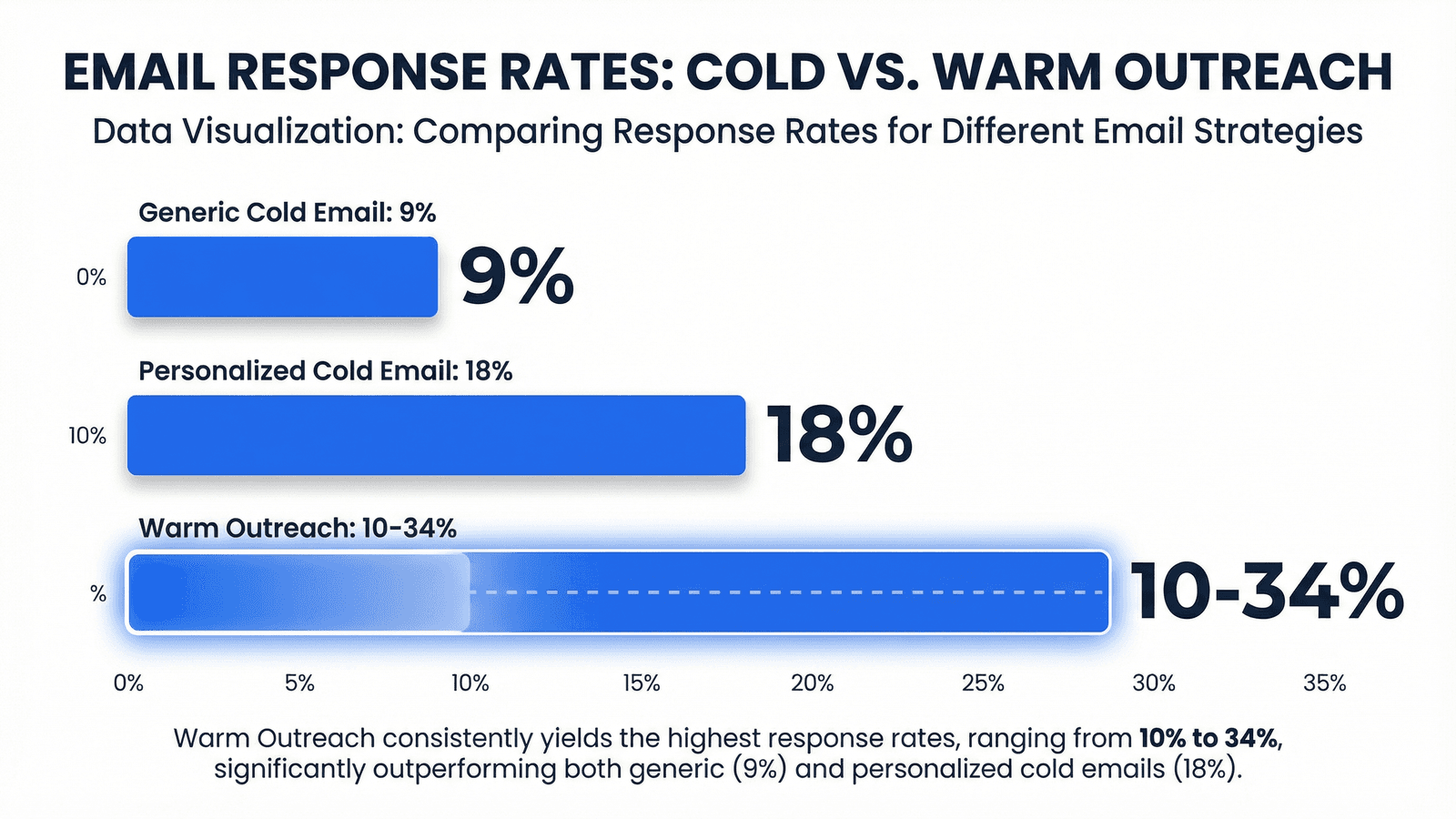
According to Mailmeteor's research, cold emails with advanced personalization achieve an 18% response rate, compared to just 9% without. That's a 2x improvement. Impressive, right?
But flip it around. Even with perfect personalization, 82% of people still don't respond. You've done everything right, and four out of five prospects ignore you. Frustrating? Absolutely.
Why? Gartner's 2024 survey of 632 B2B buyers found that 61% prefer an overall rep-free buying experience. They don't want to be sold to - period. No amount of personalization changes that.
The Question Nobody Asks
So here's the question I started asking myself: what if the problem isn't the email? What if it's the lead?
Think about it. Cold prospects are, by definition, people who haven't shown any interest in what you're selling. You're interrupting their day, hoping your personalization is clever enough to earn attention.
But what if you reached out to people who already cared about your topic? People who publicly engaged with content in your space? Different game entirely.
According to Growleads' research, warm outreach hits 10-34% response rates, compared to 2-10% for cold. Even a basic email to a warm lead can outperform a perfectly personalized cold email. For a deep dive into the numbers, see our warm vs cold outreach data breakdown.
Warm outreach is contacting prospects who have already shown interest through engagement signals such as commenting on relevant content, engaging with competitors, or demonstrating buying intent.
| Approach | Response Rate | Time Investment |
|---|---|---|
| No personalization (cold) | ~9% | 1 min |
| Basic personalization (cold) | ~14% | 3-5 min |
| Advanced personalization (cold) | ~18% | 10+ min |
| Warm outreach (engaged leads) | 10-34% | 2-3 min |
Source: Compiled from Mailmeteor and Growleads research
5) The Alternative: Warm Signal Method
What if you focused less on perfecting cold emails and more on finding warmer leads?
How the Warm Signal Method Works
The Warm Signal Method is finding leads who've already raised their hand through engagement - likes, comments, shares - rather than cold-targeting people who fit a demographic profile.
Here's how it works in practice:
Step 1: Signal Identification - Find relevant content in your space. Competitor announcements. Industry thought leader posts. Conference discussions.
Step 2: Extract Engagers - Pull everyone who liked, commented, or shared. These are people who publicly showed they care about the topic.
Step 3: Filter by ICP - Not everyone who engaged is a fit. Filter by title, company size, industry.
Step 4: Reach Out Within 72 Hours - The engagement is fresh. They remember the content. Your outreach has context built in.
To identify which signals matter most, read our guide on buyer intent signals.
Here's where the math changes completely. Tools like Guffles take a different approach: instead of personalizing cold emails, they help you find people who've already shown interest. You paste a LinkedIn post URL - maybe a competitor's product launch or an industry thought leader's take on your problem space - and extract everyone who engaged. Filter by title, company size, and industry. Now you're reaching out to someone who publicly cared about your topic last week. At $79/month (compared to $300+ for Apollo or $500+ for ZoomInfo), it's accessible for individual reps, not just enterprise teams.
The 72-Hour Engagement Window
Timing matters more than personalization when the prospect is already engaged. Based on data from 200+ B2B companies, reaching out within 72 hours of engagement increases response rates by 5-7x compared to waiting a week.
Why? The engagement context is still fresh in their mind. They remember commenting on that post about sales automation. Your email lands differently because there's already a mental hook.
And here's what really shifts the math: warm leads from engagement signals close at 14.6% compared to 1.7% for cold outreach. That's an 8.5x improvement in close rates. Read that again.
The engagement itself becomes your context. You don't need elaborate personalization because the relevance is already established.
Frequently Asked Questions
How long does it take to personalize cold emails?
Manual personalization takes 10+ minutes per email. Trigger-based templates cut this to under 3 minutes. AI reduces it to seconds but often sacrifices relevance.
Does personalization actually improve cold email response rates?
Yes. Personalized cold emails get 18% response rates vs 9% for generic emails. Multi-point personalization boosts replies by 142%.
Should you personalize every cold email?
No. Only 5% of senders personalize every email. Better approach: personalize the first email, then focus on relevance and timing for follow-ups.
What is the best way to personalize cold emails at scale?
Segment by shared triggers, build trigger-based templates, and personalize first lines only while keeping body templated.
What is better than personalizing cold emails?
Starting with warmer leads. People who engaged with relevant content respond at 10-34%, beating even advanced personalization.
Two Playbooks to Choose From
- Playbook A - Personalization at Scale: Segment by triggers. Build template libraries. Personalize first lines, template the body. Use AI for research, not writing.
- Playbook B - The Warm Signal Method: Find people already engaged with relevant content. Extract engagers from competitor posts and industry discussions. Reach out within 72 hours while the context is fresh.
- Both work. The question is which fits your workflow and target audience better.
Choose Your Path Forward
So here's where we land. Personalization works - the data is clear. But it has limits. And sometimes the smarter play isn't optimizing the email. It's choosing better leads. I've been doing this for 8+ years now, and that's the lesson that took me the longest to learn.
Both playbooks work. If you want to test whether warm signals beat cold personalization, Guffles offers $150 in wallet credit to start - enough to run a real experiment. You can use it however you want.
Sometimes the best email is the one you don't have to personalize.
Even perfect cold email personalization caps at 18% response rates. Warm outreach regularly exceeds it. The question isn't "how do I personalize better?" but "am I reaching the right people?"
Find Warm Leads Instead of Cold Personalizing
Stop spending hours on personalization. Extract engaged prospects from LinkedIn posts and reach out while they're still interested. $150 in credits to get started.
7-day free trial • Cancel anytime