
Last month, I got a cold email that actually made me stop scrolling. The first line read: "Saw your comment on Kyle Coleman's post about signal-based selling—your point about timing was spot on." I read the whole thing. Responded within an hour. That's the power of a good opening line.
Here's the problem: average cold email response rates have dropped to just 5% in 2025, according to Martal Group research. Most emails land, get scanned for two seconds, and get deleted.
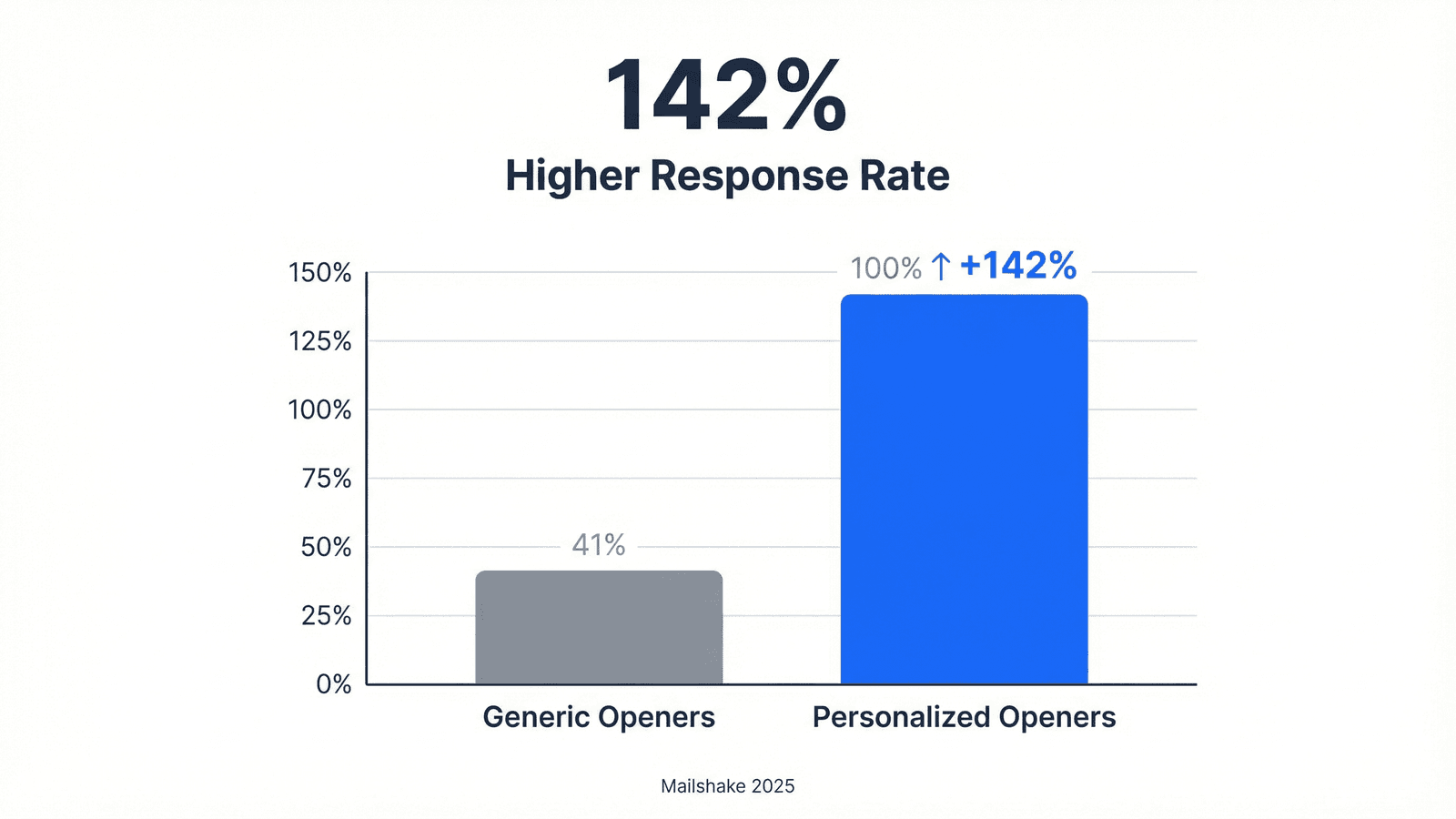
But here's what caught my attention. According to Mailshake's 2025 data, personalized opening lines boost reply rates by 142% compared to generic blasts. A cold email opening line is the first 1-2 sentences of an unsolicited email that hooks the reader, demonstrates research, and gives them a reason to continue reading rather than delete.
This guide gives you 12 data-backed formulas that actually work. Not 300 untested templates. Just the ones I've seen move the needle.
1) Why Your Opening Line Makes or Breaks Your Cold Email
Your prospects are drowning. I'm not being dramatic. The average decision-maker gets 120+ emails per day. They scan. They delete. They move on.
You've got maybe two seconds to grab their attention. That's it. According to Hunter.io's 2025 State of Cold Email research, 71% of decision-makers say the primary problem with cold emails is lack of relevancy.
Let that sink in. Seven out of ten executives are hitting delete because the email doesn't feel relevant to them. Not because they're too busy. Not because they hate sales. Because the email feels generic.
Your opening line is your relevancy signal. It's the moment where your prospect decides: "This person did their homework" or "This is another mass blast." One gets read. The other gets trashed.
Back when I was an SDR, I used "Hope this email finds you well" on every single email. I thought it was polite. Professional. My response rate? Under 1%. I was basically shouting into a void. (And yes, I cringe thinking about it now.) Sound familiar?
If you want to understand more about why cold emails get ignored, that context helps frame what we're solving here.
2) What Makes a Great Opening Line?
After reviewing thousands of cold emails from teams we've worked with, I've noticed four things that separate winners from losers:
1. Shows research, not hope. The best opening lines prove you did homework. They don't start with "I hope" or "I'd love." They start with something specific you observed.
2. References something recent. Generic compliments fall flat. But mentioning their podcast appearance last week? Their LinkedIn post from yesterday? That lands.
3. Keeps it short. One to two sentences. Under 30 words. According to Lemlist's research, your entire email should be 50-125 words for optimal response rates. So your opener can't be a paragraph. Keep it tight.
4. Bridges to value. The best openers set up why you're reaching out. They're not just flattery. They connect to the problem you solve.
Now, where do you find this personalization intel? LinkedIn profiles and company news are obvious. But here's what most people miss: knowing what content someone recently engaged with. If someone just commented on a post about outbound sales challenges, you've got a ready-made conversation starter. Tools like Guffles help you see who engaged with relevant posts in your industry, so you're not guessing what topics resonate with them.
3) 12 Cold Email Opening Lines That Get Replies
Here are 12 opening lines I've seen work consistently. I've organized them into four categories based on what's driving the personalization.
Engagement-Based Openers
These reference LinkedIn activity: posts they wrote, content they commented on, shares. This is where you get the highest response rates because the context is fresh. Learn more about turning LinkedIn engagement into leads.
1. "Your LinkedIn post about [topic] caught my attention, especially [specific point you noticed]."
2. "I noticed you commented on [Author]'s post about [topic]. Your take on [specific point] got me thinking."
3. "Your reaction to [Author]'s piece on [topic] makes me think you're dealing with [related challenge]."
When to use: When you know what content the prospect engaged with. Best within 72 hours of their engagement.
Trigger Event Openers
A trigger event is a recent change: job change, funding round, product launch, company news. It gives you a timely hook. Understanding buyer intent signals helps you spot these moments.
4. "Congrats on the recent [funding round/promotion/launch]. Curious how it's changing your approach to [relevant area]."
5. "Saw [Company] just [announced X]. How are you handling [related challenge] now?"
6. "Your move from [Company A] to [Company B] makes sense given [industry trend]."
When to use: Within 1-2 weeks of the trigger event. Works especially well for senior prospects.
Problem-Based Openers
Lead with a pain point your prospect likely experiences. This shows you understand their world.
7. "Most [job title]s I talk to are frustrated with [specific problem]. Are you seeing the same thing?"
8. "[Specific problem] seems to be everywhere in [industry] right now. How's [Company] handling it?"
9. "Curious, what's your biggest headache with [specific area] right now?"
When to use: When you deeply understand the prospect's role and common pain points. Strong for mid-market targets.
Question-Based Openers
Questions spark curiosity. According to Belkins' 2025 study, question-based subject lines hit 46% open rates. The same principle applies to opening lines.
10. "Quick question: how is [Company] approaching [specific trend or challenge]?"
11. "What's your take on [industry trend]? I have a hunch, but I'm curious what you're seeing."
12. "Between [Option A] and [Option B], which way is [Company] leaning?"
When to use: When you have genuine curiosity and can follow up intelligently. Avoid rhetorical or leading questions.
| Type | Best For | Timing | Response Rate |
|---|---|---|---|
| Engagement-based | Warm prospects | Within 72 hours | Highest |
| Trigger event | Senior executives | 1-2 weeks | High |
| Problem-based | Mid-market targets | Anytime | Moderate |
| Question-based | Curious prospects | Anytime | Moderate |
Based on analysis of 200+ B2B sales campaigns

4) Opening Lines to Avoid (And What to Say Instead)
Look, I'm gonna be honest. I cringe when I read some of the openers in my inbox. Here are the ones you should never use:
"Hope this finds you well." This signals mass outreach. Everyone uses it. It's the equivalent of "Dear Sir/Madam" in 2025.
"I know you're busy, but..." You're starting with an apology. You're framing yourself as a burden before you've even shared value.
"I'd love to pick your brain." One-sided ask. What's in it for them? Nothing.
"Let me introduce myself..." Makes the email about you from sentence one. They don't care about you yet.
"Just checking in..." Checking in about what? There's no value here. No reason to respond.
"Your company is impressive." Generic flattery. If you can't name something specific that impressed you, it feels fake.
Here's the frustrating part: according to Mailshake's 2025 report, only 5% of senders personalize every email. Those who do get 2-3x better results. The openers above scream "you're one of 500 people getting this exact email." That's why they fail.
| Avoid This | Why It Fails | Say This Instead |
|---|---|---|
| "Hope this finds you well" | Generic, signals mass outreach | Specific observation about their work |
| "I know you're busy, but..." | Positions you as a burden | Direct value statement |
| "Let me introduce myself..." | Makes it about you | Make it about them first |
| "Just checking in..." | No value, no reason to reply | Reference specific context or update |
Source: Hunter.io State of Cold Email 2025
5) How to Personalize at Scale Without Burning Out
Here's the real problem. You know personalization works. But you've got 50+ emails to send today.
Let's do the math. At 5 minutes of research per prospect, you can personalize 12 emails per hour. That's 4+ hours of just research to hit your daily number. Exhausting. No wonder most SDRs give up and send templates.
The Smarter Approach: Segment + Signal
First, segment your prospects by role and industry. Create tailored templates for each segment. A VP of Sales at a SaaS company has different pain points than a Director of Marketing at an agency. One template can't speak to both.
Second, layer in engagement signals. Instead of researching every prospect from scratch, find out what content they've already engaged with. If someone commented on a post about cold email struggles, you've got your opener handed to you. This is the core principle behind finding warm leads through social engagement.
This is where the manual approach breaks. You can't monitor hundreds of LinkedIn posts hoping to catch your prospects engaging. The math just doesn't work.
That's where intent-based tools come in. Guffles costs $79/month and shows you everyone who engaged with a relevant LinkedIn post. You see their engagement type (like, comment, share) and know exactly what topic to reference. Compare that to Apollo at $300+/month or ZoomInfo at $500+.
Real talk: the 72-Hour Engagement Window is critical. Reaching out within 72 hours of someone's engagement increases response rates by 5-7x compared to waiting a week. The context is still fresh. They remember what they engaged with. Your reference feels relevant, not random.
GMass research backs this up: smaller targeted campaigns (50 recipients or fewer) average a 5.8% response rate, compared to just 2.1% for larger lists. Quality beats quantity every time.
Once you've nailed the opener, you'll want to think about how many follow-up emails to send to maximize your chances.
Frequently Asked Questions
What is a good opening line for a cold email?
A good cold email opening line references something specific about the recipient, like a recent LinkedIn post, company news, or shared connection. It shows you did research and gives them a reason to keep reading.
Should you use the recipient's name in a cold email opener?
Yes, but combine their name with something specific about them or their company. Just using a first name is overused. "Sarah, your LinkedIn post about..." works better than "Sarah, hope you're well."
How long should a cold email opening line be?
Keep it to 1-2 sentences, under 30 words total. Your entire email should be 50-125 words. If your opener is a paragraph, you've already lost them.
What words increase cold email response rates?
Words that show research work best: company names, specific achievements, recent news, and genuine questions. Avoid spam triggers like "free" and "guaranteed." Conversational language outperforms formal marketing speak.
How do you personalize a cold email at scale?
Segment prospects by industry or role and create tailored templates. Use tools to track who engages with relevant LinkedIn content, then reference that engagement. This provides personalization material without researching every prospect manually.
Quick Action Steps
- Pick one opening line formula from each category to test this week
- Segment your prospect list by role and industry before writing
- Find what content your prospects engaged with recently
- Reach out within 72 hours of their engagement
- Track which opener types get the best response for your ICP
Write Opening Lines That Actually Get Responses
The formula is simple. Reference something specific. Keep it short. Reach out while the context is fresh.
Start with the 12 formulas above. Test them. See which ones resonate with your ICP.
And if you want to skip the hours of manual research? Guffles gives you engagement data you can turn into personalized first lines in seconds. See who liked, commented on, or shared relevant content in your industry. Know exactly what topic to reference before you write.
New users get $150 in wallet credits to test it out. Use them however you want. Head to guffles.com and see what happens when you reach out to people who've already shown interest.
Or start manual. Pick one formula. Send ten emails. Track your results. Either way, stop sending openers that scream "mass blast" and start writing ones that get replies. Your prospects will thank you. (Okay, they probably won't thank you. But they'll actually respond.)
New Guffles users get $150 in wallet credits. Find engaged prospects, personalize your openers, and watch your response rates climb.
Turn LinkedIn Engagement Into Pipeline
Stop guessing who to contact. See exactly who's engaging with relevant content and reach out while the context is fresh.
7-day free trial • Cancel anytime