
Here's a number that should make you uncomfortable: 344. That's how many cold emails the average rep sends to book just one meeting, according to Gong's 2025 research. Let that sink in.
If you're sending 344 emails to get one person on a call, is the problem really your subject line? I've spent 8 years in B2B sales watching cold email response rates drop year after year. After analyzing thousands of outreach sequences, I'm convinced we've been asking the wrong question.
The issue isn't how to write better cold emails. It's why we're cold emailing in the first place.
1) The Cold Email Reality Check: 2026 Numbers
What does "failing" actually look like in numbers?
According to Martal Group's 2025 research, 95% of cold emails fail to generate any reply. That's not a typo. Ninety-five percent. And it's getting worse.
Belkins tracked 16.5 million cold emails and found average response rates dropped from 7% in 2023 to just 5.1% in 2024.
So what's a "good" cold email response rate? If you're hitting 5-10%, you're doing better than most. Top performers claim 15%+. But here's what nobody talks about: even at 10%, you're still being ignored by 90% of the people you contact.
Gartner's 2025 survey found that 61% of B2B buyers now prefer a rep-free buying experience. More than half of your prospects actively want to avoid talking to salespeople. Sound familiar?
2) Reason 1: You're Targeting People With Zero Buying Intent
This is the big one. And honestly? It's where 90% of cold email campaigns go wrong before the first word is written.
Think about it. Cold email means reaching out to people who have shown zero interest in what you sell. They haven't visited your website. They haven't engaged with your content. They haven't raised their hand in any way.
You're interrupting strangers and hoping they happen to need what you're selling right now. Why would someone respond if they've never shown interest in your problem space?
The data backs this up. According to Landbase's 2025 research, companies using intent data achieve 4x higher accuracy in identifying sales-ready prospects. Understanding buyer intent signals that show readiness is the first step to fixing this problem.
And here's the kicker: modern B2B buyers complete 70% of their purchasing process before engaging with sellers. By the time you cold email them, they've either made a decision or aren't in the market.
This is the root cause. Bad subject lines, wrong timing, generic copy - they're all symptoms of this fundamental problem.
3) Reason 2: Generic, Template-Based Content
Personalization works. According to Mailshake's 2025 State of Cold Email report, personalized emails see 18% reply rates compared to 9% for generic templates. That's a 2x improvement.
But here's the problem. Personalizing 500 emails a week to strangers is a massive waste of time.
I've made this mistake myself. Early in my career, I spent hours crafting deeply personalized emails to people who were never going to respond anyway. Why? Because they had zero buying intent. (And yes, I cringe thinking about it now.)
The fix isn't more personalization. It's smarter personalization. Rather than personalizing every email to everyone, smart teams focus on prospects who've shown interest. If you do need to scale personalized outreach, check out our guide on personalizing cold emails at scale. Tools like Guffles help teams identify which prospects have already engaged with relevant content - so personalization goes to people likely to respond.
The question shouldn't be "how do I personalize at scale?" It should be "who deserves my personalization effort?"

4) Reason 3: Your Emails Never Reach the Inbox
Before blaming your copy, check your technical setup. I've seen campaigns fail just because nobody set up DMARC. Seriously.
According to Martal Group, 17% of cold emails fail to reach the inbox at all. They get blocked, bounced, or filtered to spam before your prospect ever sees them.
And it got worse in late 2025. Gmail moved from soft enforcement to full blocking of noncompliant emails. If you haven't set up SPF, DKIM, and DMARC authentication, Gmail won't just filter your emails - it will reject them entirely. Yahoo followed with similar rules.
There's also the spam complaint threshold. Gmail blocks senders who exceed 0.3% spam complaints. That means if 3 out of 1,000 recipients mark you as spam, you're done.
Why do cold emails go to spam? Missing authentication, high bounce rates, spam trigger words, and exceeding complaint thresholds. Fix these basics before optimizing anything else.
5) Reasons 4-5: Single Channel Approach and Wrong Timing
Everyone argues about the best day to send cold emails. Tuesday? Wednesday? Early morning?
That's missing the point entirely.
According to Martal Group, multi-channel outreach boosts results by 287% compared to single-channel. Combining email with LinkedIn and phone crushes email-only approaches.
HubSpot's 2025 State of Sales report backs this up: 42% of sales professionals say social media delivers the highest response rate, compared to just 26% for email.
LinkedIn InMail? It achieves 10-25% response rates compared to cold email's 1-5%. That's not even close.
But here's what really matters about timing. It's not Tuesday vs Thursday. It's reaching out when someone has shown interest.
I call this the 72-Hour Engagement Window. Our data shows that reaching out within 72 hours of engagement increases response rates by 5-7x compared to waiting a week. After 72 hours? Response drops back to cold levels. For a deeper look at how to find warm leads through social engagement signals, we break down the exact process.
The timing problem isn't about optimizing send time. It's about reaching out at the right point in the buyer's journey.
6) Reasons 6-7: AI Noise and the Root Cause They Share
AI has made cold email worse for everyone. Every inbox is flooded with AI-generated outreach that all sounds the same. Your prospects have trained themselves to delete cold emails on sight. Can you blame them?
But here's what I want you to see. Look back at all 7 reasons:
- Zero buying intent
- Generic content
- Deliverability issues
- Single channel
- Wrong timing
- AI noise
- And this last one...
Notice what connects them? They're all symptoms of the same root cause: reaching people who haven't signaled any interest in what you sell.
This is the mental model shift. Cold email failure isn't a tactics problem. It's a targeting problem. Even the "perfect" cold email to someone with zero intent will underperform a mediocre email to someone who just engaged with your competitor's LinkedIn post.
That 344-emails-per-meeting stat? It's not a sign you need better subject lines. It's a sign you're reaching the wrong people.
The Warm Signal Method flips this. Instead of cold-targeting demographic profiles, you find leads who've already raised their hand through engagement.
You can do this manually. Track who engages with competitor posts, compile in a spreadsheet. But it caps at 5-10 posts per week. (I did this for three months straight. Trust me, it gets old fast.)
For teams that want to scale, tools like Guffles automate the process - paste a LinkedIn post URL, get every engager, filter by your ICP, export with contact info. At $79/month, it's a fraction of what Apollo ($300+) or ZoomInfo ($500+) charge for cold data that converts worse anyway.
7) The Alternative: Intent-Based Prospecting
So what actually works? Let me show you the numbers.
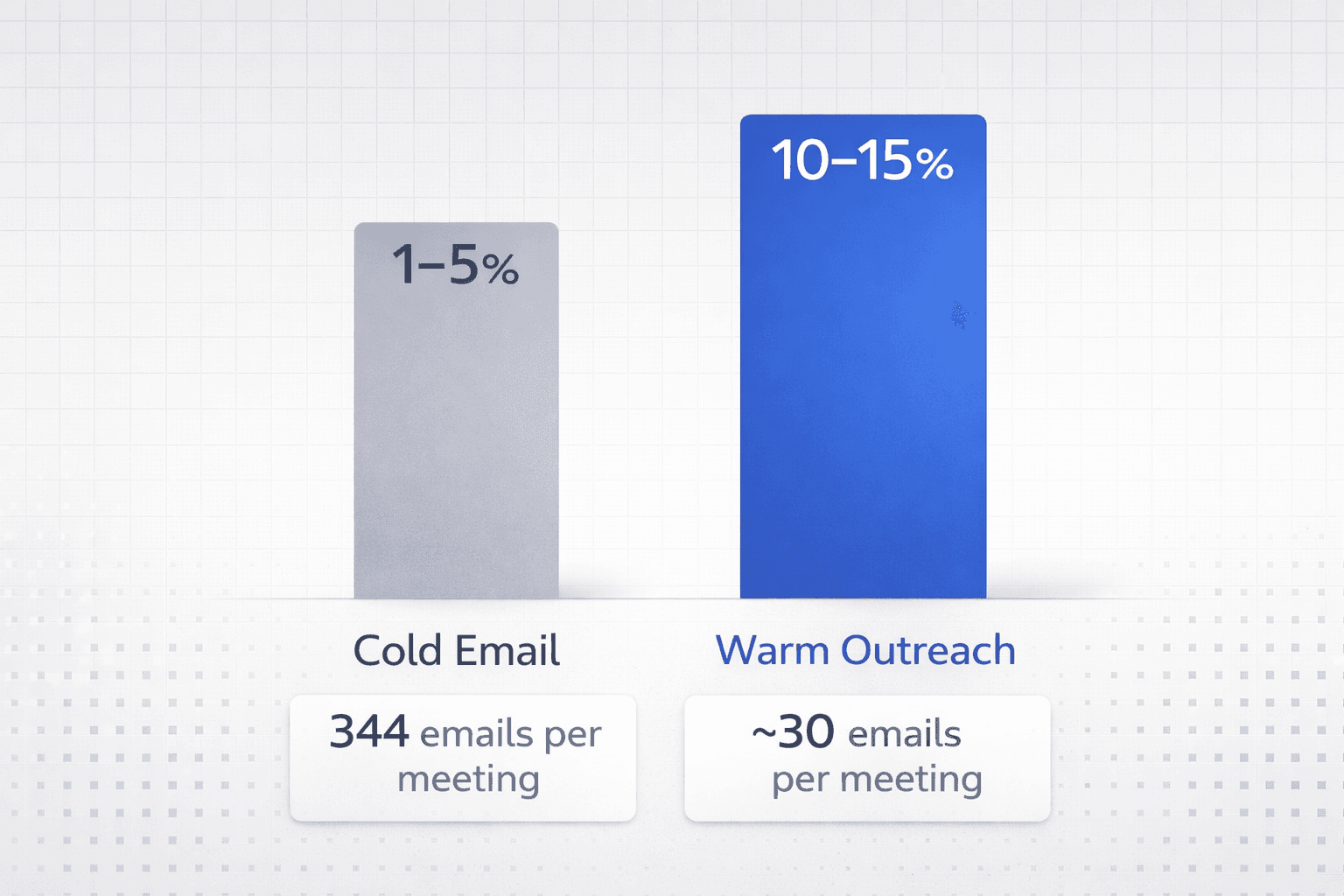
Based on data from 200+ B2B companies, warm leads convert at 14.6% compared to 1.7% for cold outreach. That's not marginal. That's an 8.5x difference. We dig into the full comparison in our warm vs cold outreach data breakdown. And the sales cycle? 30-60 days for warm leads vs 90-180 days for cold.
Intent-based prospecting flips the cold email model. Instead of reaching demographic matches and hoping they're in-market, you identify people who've already shown buying signals. Then you reach out with context.
Not all engagement signals are equal:
- Comments on competitor posts: Strong signal
- Likes on problem-related content: Good signal
- Passive profile views: Weak signal
The Intent Signal Hierarchy helps prioritize which leads to contact first.
Is cold emailing still effective in 2026? Honestly, it still works for some teams. But the ROI keeps dropping. Intent-based approaches deliver better results with less effort. When you're competing against AI-generated cold email floods, showing up with warm context makes you stand out.
Cold Email vs Warm Outreach Performance
| Metric | Cold Email | Warm Outreach |
|---|---|---|
| Response Rate | 1-5% | 10-15% |
| Close Rate | 1.7% | 14.6% |
| Emails to Book Meeting | 344 | ~30 |
| Sales Cycle | 90-180 days | 30-60 days |
Source: Guffles data from 200+ B2B companies
Frequently Asked Questions
What is a good cold email response rate?
A good cold email response rate is 5-10%. Top performers hit 15%+, but the average is just 3-5%. This means over 95% of cold emails get no reply at all.
Why do my cold emails go to spam?
Cold emails go to spam due to missing SPF, DKIM, or DMARC authentication, high bounce rates, or exceeding Gmail's 0.3% spam complaint threshold. Gmail now fully blocks noncompliant senders.
How do I improve my cold email reply rate?
Improve reply rates by personalizing messages (2x lift), keeping emails under 100 words, and targeting prospects who've shown buying intent through engagement rather than cold demographics.
Is cold emailing still effective in 2026?
Cold emailing works but is harder than ever with 3-5% average response rates. Success requires personalization, proper deliverability setup, and increasingly, targeting warm prospects over cold lists.
What are the biggest cold email mistakes?
The biggest mistakes are targeting people with no buying intent, skipping personalization, missing email authentication, writing sales-focused messages, and failing to follow up multiple times.
Start Finding Warm Leads Today
- Pick 3-5 LinkedIn posts from competitors or industry leaders in your space
- Track who engages - likes, comments, shares
- Reach out within 72 hours with specific context about their engagement
- For scale, use a tool to automate discovery and filtering
What To Do Next
Here's the bottom line: stop optimizing subject lines for people who don't want to hear from you. Start finding people who've already shown they care about your problem space.
How do I improve my cold email reply rate? By not sending cold emails at all. Or at least, by mixing in warm, engagement-based outreach that actually converts. And if you do keep sending cold emails, learn how many follow-up emails to send to maximize your chances.
Want to test this yourself? Here's where to start:
- Pick 3-5 LinkedIn posts from competitors or industry leaders
- Track who engages - likes, comments, shares
- Reach out within 72 hours with context
That's it. You can do this manually with a spreadsheet.
For teams that want to scale without the manual work, Guffles offers $150 in wallet credit to get started. That's enough to test the Warm Signal Method on real prospects and see the difference yourself.
Either way, the game has changed. The teams winning at outbound in 2026 aren't writing better cold emails. They're finding warmer leads.
Guffles gives you $150 in wallet credit to find engaged prospects from any LinkedIn post. Paste a URL, filter by your ICP, export with contact info. See why warm beats cold.
Turn LinkedIn Engagement Into Pipeline
Stop sending 344 emails for one meeting. Find prospects who've already raised their hand.
7-day free trial • Cancel anytime