
You've probably heard that 80% of sales require at least 5 follow-ups. But here's what nobody mentions: sending 4+ emails triples your spam complaint rates, according to Belkins' analysis of 16.5 million cold emails. So which is it? Be persistent or get marked as spam? I've spent eight years figuring out this exact question. And honestly? The answer isn't what most people think.
Key Definitions
Warm Lead: A warm lead is a prospect who has already shown interest through engagement - likes, comments, or shares - before being contacted.
Cold Lead: A cold lead is a prospect with no prior interaction or awareness of your company, contacted based purely on demographic fit rather than demonstrated interest.
Follow-Up Email Sequence: A follow-up email sequence is a series of pre-planned emails sent at strategic intervals - typically 2-5 days apart - to nurture prospects who haven't responded.
1) The Follow-Up Paradox: Why Generic Advice Fails
Here's the thing that drives me crazy about most follow-up advice: it treats every prospect the same. And that's a problem.
HubSpot data shows 44% of salespeople give up after just one follow-up attempt. And 60% of B2B prospects say no four times before saying yes. So the standard advice is simple: keep following up.
But that's incomplete. Way incomplete.
I used to send 5-8 follow-ups to every prospect on my list. Same sequence, same timing, same approach. Some people responded. Most didn't. And my sender reputation? It took a beating. (I learned this the hard way. Twice.)
Then I noticed something weird. The prospects who'd already engaged with our content somehow - liked a post, commented on an article, visited our website - they responded way faster. Often on the first or second follow-up.
The cold prospects? They needed more touches. Sometimes they never responded at all. Frustrating.
The missing piece in all that generic advice? Not all leads are created equal. The optimal number of follow-ups depends entirely on how warm your leads are before you hit send.
Generic follow-up advice fails because it ignores lead quality, which is the single most important variable in determining how many emails to send.
2) Warm vs Cold - The Hidden Variable
Let me be clear about what I mean by warm and cold leads. This distinction changes everything.
A warm lead is a prospect who has shown prior engagement or interest - through actions like liking a LinkedIn post, commenting on content, or visiting your website - before being contacted directly.
A cold lead is a prospect with no prior interaction or awareness of your company. You're reaching out based purely on demographic fit, not demonstrated interest.
Why does this matter? Look at the data.
Industry benchmarks show warm leads convert at 14.6% compared to just 1.7% for cold leads. That's an 8.5x improvement. Not 10%. Not 20%. Eight and a half times better. Warm leads also close in 30-60 days on average, while cold leads take 90-180 days.
I've seen this play out hundreds of times. When I reach out to someone who just commented on a competitor's post about sales automation, they already know the problem exists. They're already thinking about solutions. My email lands in a receptive inbox.
When I cold email someone who fits my ICP but has never heard of me? I'm starting from scratch. Every single follow-up is building familiarity that a warm lead already has. It's exhausting.
So where do you find warm leads? Some teams manually track who engages with their LinkedIn content. Others use tools like Guffles to extract everyone who likes, comments, or shares posts in their niche - giving them a list of people who've already shown interest in relevant topics. You can also find warm leads through social signals by monitoring competitor content and industry thought leaders.
Either way, the principle is the same: engagement signals equal warmer leads. And warmer leads need fewer follow-ups.
The warm vs cold outreach data backs this up consistently.
Warm leads convert at 14.6% versus 1.7% for cold leads, which means lead temperature determines how many follow-ups you actually need.
3) The Optimal Follow-Up Count by Lead Type
So how many follow-ups should you actually send? Real talk: it depends on lead temperature.
After eight years and thousands of outreach sequences, here's what actually works:
The magic number is not five follow-ups for everyone - it is 2-3 for warm leads and 4-5 for cold leads.
| Factor | Warm Leads | Cold Leads |
|---|---|---|
| Recommended follow-ups | 2-3 | 4-5 |
| Response rate | 10-15% | 1-2% |
| Conversion rate | 14.6% | 1.7% |
| Sales cycle | 30-60 days | 90-180 days |
| First follow-up timing | 2-3 days | 3-5 days |
| Tone | Reference engagement | Add new value |
Source: Industry benchmarks and Guffles data from 200+ B2B companies
3a) The Warm Lead Follow-Up Formula
Warm leads don't need aggressive persistence. They already recognize your name (or at least your topic). Here's what I use:
Day 0 - Initial Outreach: Reference their engagement directly. "Noticed you engaged with [post/topic] - thought you might find this useful..." Keep it short. The engagement context does the heavy lifting.
Day 2-3 - First Follow-Up: Add specific value. Share a relevant insight, stat, or resource. No "just checking in." That's lazy. They'll ignore it.
Day 7 - Second Follow-Up: Include social proof or a case study. "We helped [similar company] achieve [result]..." Make it relevant to their situation.
Day 14 - Final Touch: Offer an alternative channel or softer CTA. "No pressure - would a quick LinkedIn chat work better?"
That's it. Four touches total over two weeks. Simple.
Why so few? Because of what I call the 72-Hour Engagement Window. Our data shows that reaching out within 72 hours of engagement increases response rates by 5-7x compared to waiting a week. Five to seven times. The engagement context is still fresh in their mind.
When you catch someone in that window and reference what they engaged with, you don't need 8 follow-ups to build familiarity. They already know why you're reaching out. It feels less like cold outreach and more like a warm introduction.
Woodpecker data confirms this: the first follow-up generates 40% higher response than the initial email. But for warm leads, that response often comes by the second or third touch.
Warm leads need only four total touches over two weeks because they already have context from their prior engagement.
3b) The Cold Lead Persistence Framework
Cold leads require more patience. They don't know you, don't know your company, and probably don't even know they have the problem you solve. Tough starting point. Here's what works:
Day 0 - Initial Cold Email: Lead with value, not your pitch. Focus on their pain point, not your product.
Day 3 - First Follow-Up: New value angle. Share a relevant stat or insight they haven't seen. Don't just bump the thread. That's annoying.
Day 7 - Second Follow-Up: Social proof time. "Here's how [similar company] solved this..." Give them a reason to believe.
Day 14 - Third Follow-Up: Try a different approach - ask a question, share a resource, or send a quick video message. Change the pattern.
Day 21 - Breakup Email: Politely close the loop. "Seems like timing isn't right - I'll check back in a few months." Sometimes this triggers a response. Sometimes it doesn't.
Five touches over three weeks. Longer timeline, more emails.
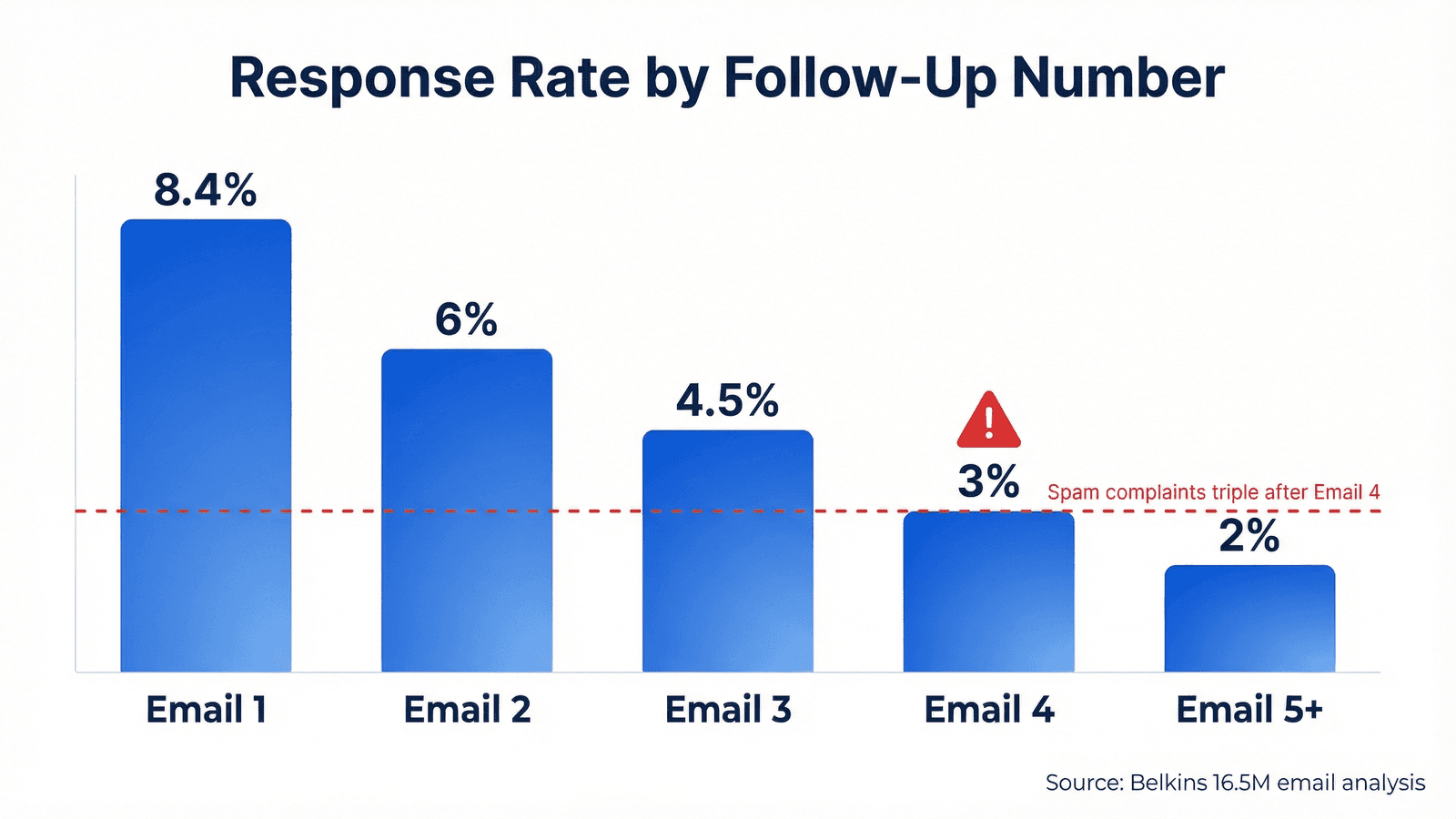
But here's the catch: Belkins' research on 16.5 million cold emails shows reply rates peak at 8.4% with a single email, then decline with each follow-up. And after email four? Spam complaints triple. Scary, right?
So yes, cold leads need more follow-ups. But each one must add genuine value. If you're just "checking in" or "bumping this to the top of your inbox," you're training prospects to ignore you. (And yes, I've made this mistake too.)
The challenge is scale. Manually tracking engagers works great for 5-10 posts. But what about monitoring all your competitors' content? Or industry thought leaders in your space? That's where tools like Guffles come in at $79/month - a fraction of what Apollo ($300+) or ZoomInfo ($500+) charge. You paste a LinkedIn post URL, and it extracts every person who engaged, filtered by your ICP criteria. The result: a list of warm leads who need 2-3 follow-ups instead of 5-8.
You can also turn LinkedIn engagement into leads through manual tracking if you want to test the approach first.
Cold leads need five touches over three weeks, but each follow-up must add new value or you will damage your sender reputation.
4) Timing Between Follow-Ups: What the Data Says
How long should you wait between follow-ups? I learned this one the hard way.
Early in my career, I'd follow up the next day if I didn't hear back. Seemed logical. Stay top of mind, right?
Wrong. So wrong. Belkins data shows next-day follow-ups actually reduce replies by 11%. But waiting 2-3 days? That increases replies by 31%.
Here's what I use now:
- First follow-up: 2-3 days (gives them time to read, not enough to forget)
- Second follow-up: 4-5 days (extends the gap slightly)
- Third+ follow-ups: 7+ days (respect their inbox)
- C-level executives: Add 2-3 extra days (busier schedules)
The key is giving people breathing room. Your email isn't the only thing in their inbox. They're busy. They have other priorities. A next-day follow-up feels pushy. A 3-day gap feels professional.
Sound familiar? That feeling when someone messages you three times in 24 hours? Your prospects feel the exact same way.
Wait 2-3 days for the first follow-up, 4-5 days for the second, and 7+ days after that because next-day follow-ups reduce replies by 11%.
5) When to Stop Following Up
Knowing when to stop matters as much as knowing when to persist. Maybe more.
Belkins' 16.5M email analysis shows reply rates drop below 3% after the fifth email. And spam complaint rates triple after email four. At some point, you're doing more damage than good. You need to accept that.
Here's my rule:
For warm leads: Stop after 3 follow-ups with zero engagement signals. If they've opened emails but never replied, maybe try switching to LinkedIn. But if there's no activity at all? Move on. Seriously.
For cold leads: Stop after 5 follow-ups or any negative signal. An unsubscribe, a bounce, a spam complaint, or a direct "not interested." Those are clear signals. Respect them.
Universal stop signs:
- Direct opt-out request
- Email bounces
- Spam complaint
- "Please remove me from your list"
Softer signals (consider channel switching, not more emails):
- Multiple opens but no reply
- Clicked a link but didn't respond
- Viewed your LinkedIn profile
That last category is interesting. If someone's opening your emails and checking out your profile but not replying, they might be interested but not ready. A LinkedIn connection request or a different approach might work better than email #6. Know when to switch tactics.
Stop after three follow-ups for warm leads or five for cold leads because after that point, spam risks outweigh potential responses.
6) Beyond Email - The Multi-Channel Approach
Email alone has limits. But here's where it gets interesting.
LinkedIn data shows InMails achieve 18-25% response rates when done right. That's way higher than cold email's typical 3%. Big difference.
And Belkins found that combining email with LinkedIn profile views boosts reply rates to 11.87%. That's a real jump from email-only sequences.
My go-to multi-channel approach:
- View their LinkedIn profile (creates curiosity)
- Send the first email
- Send LinkedIn connection request on day 2-3
- Follow up via email
- If connected, try LinkedIn messaging
This works especially well with warm leads who are already active on LinkedIn. If they engaged with a post there, they're probably checking notifications regularly. Makes sense, right?
The goal isn't to overwhelm them across channels. It's to meet them where they're most likely to respond. Simple as that.
Combining email with LinkedIn profile views increases reply rates to 11.87%, so meet prospects where they are most active.
Frequently Asked Questions
How many times should you follow up after no response?
Send 2-3 follow-ups for warm leads or 4-5 for cold leads. Spam risks triple after 4 emails, so lead quality determines the right number.
How many follow-up emails is too many?
More than 5 follow-ups is too many. After 4 emails, spam complaints triple and response rates drop below 3%. The sweet spot is 2-3 for warm leads, 4-5 for cold leads.
How long should you wait between follow-up emails?
Wait 2-3 days for the first follow-up, 4-5 days for the second, and 7+ days after. Next-day follow-ups reduce replies by 11%, while waiting 2-3 days increases replies by 31%.
Do follow-up emails actually work?
Yes. Adding one follow-up increases reply rates from 9% to 13%. The first follow-up generates 40% higher response than your initial email. Without follow-ups, you miss 80% of potential sales.
Is it rude to send follow-up emails?
No. 60% of B2B prospects say no four times before saying yes. Follow-ups are expected in B2B sales. Space them 2-5 days apart and provide value each time.
Quick Action Steps
- Identify if your lead is warm (prior engagement) or cold (no contact)
- For warm leads: Send 2-3 follow-ups over 2 weeks, reference their engagement
- For cold leads: Send 4-5 follow-ups over 3 weeks, add new value each time
- Space follow-ups 2-5 days apart (never next-day)
- Stop after 3-5 follow-ups or any negative signal
Stop Chasing Cold Leads
Look, the data is clear: lead quality beats persistence volume every time. Every. Single. Time.
Warm leads need 2-3 follow-ups. Cold leads need 4-5. But if you can flip more of your pipeline from cold to warm, you'll spend less time following up and more time closing. That's the real game.
Here's the key insight: The best follow-up strategy is starting with warmer leads.
You have two options. Start manually - track who engages with 3-5 LinkedIn posts this week and reach out within 72 hours. Or scale from day one with Guffles, which gives you $150 in wallet credit to find warm leads across unlimited posts.
Either way, the math works out. Warmer leads, fewer follow-ups, better results. Your inbox (and your prospects) will thank you.
Need help getting started? Check out how to build a prospect list that actually converts.
Get $150 in wallet credit to test engagement-based lead discovery. See why warm leads need half the follow-ups.
Turn LinkedIn Engagement Into Pipeline
Stop guessing which leads to follow up with. Find prospects who've already shown interest in your space.
7-day free trial • Cancel anytime