
You finally have warm leads. Not cold lists from some sketchy database. Real people who've shown actual interest in what you sell. So why isn't your conversion rate higher?
I've been there. In my 8 years of B2B sales, I've watched teams celebrate getting warm leads only to fumble the handoff from "interested" to "closed." The expectation is that warm leads practically close themselves. The reality? Most teams still underperform.
A warm lead is a prospect who has shown interest through engagement. They've liked your content, commented on a post, downloaded something useful. They know you exist. But they haven't bought yet.
And that's where everything falls apart.
According to industry benchmarks, warm leads convert at 10-25% compared to just 1-5% for cold leads. That's a massive advantage. (For a deep dive on the numbers, see our warm vs cold outreach data breakdown.) But here's the thing: most teams don't hit anywhere near those numbers.
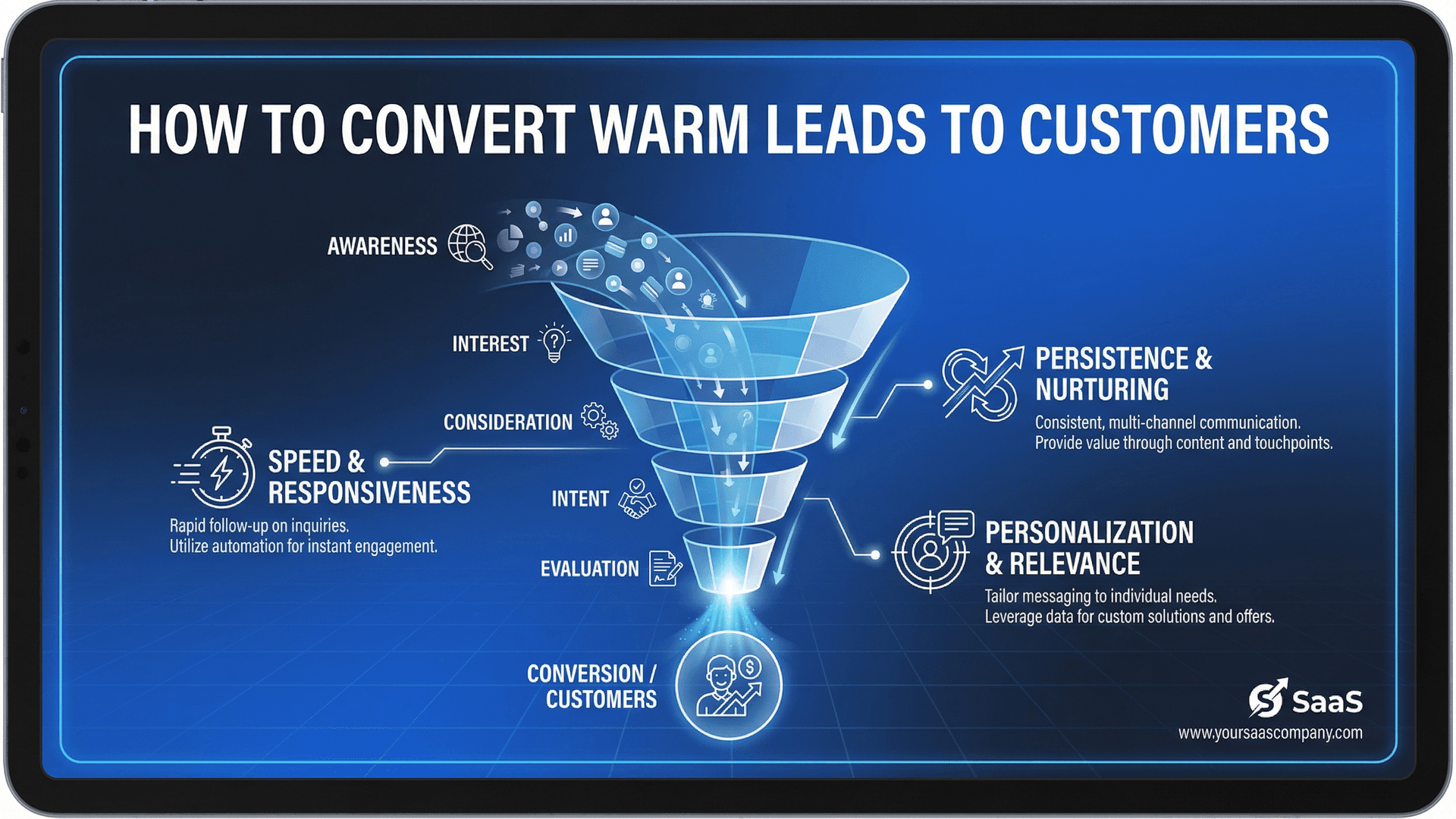
Why? Three reasons. Speed. Persistence. Personalization. Get these wrong, and your warm leads go cold fast.
I'm going to break down 10 tips across these three pillars. No fluff. Just what actually works.
What Is a Good Warm Lead Conversion Rate?
Before we get into tactics, let's set a benchmark.
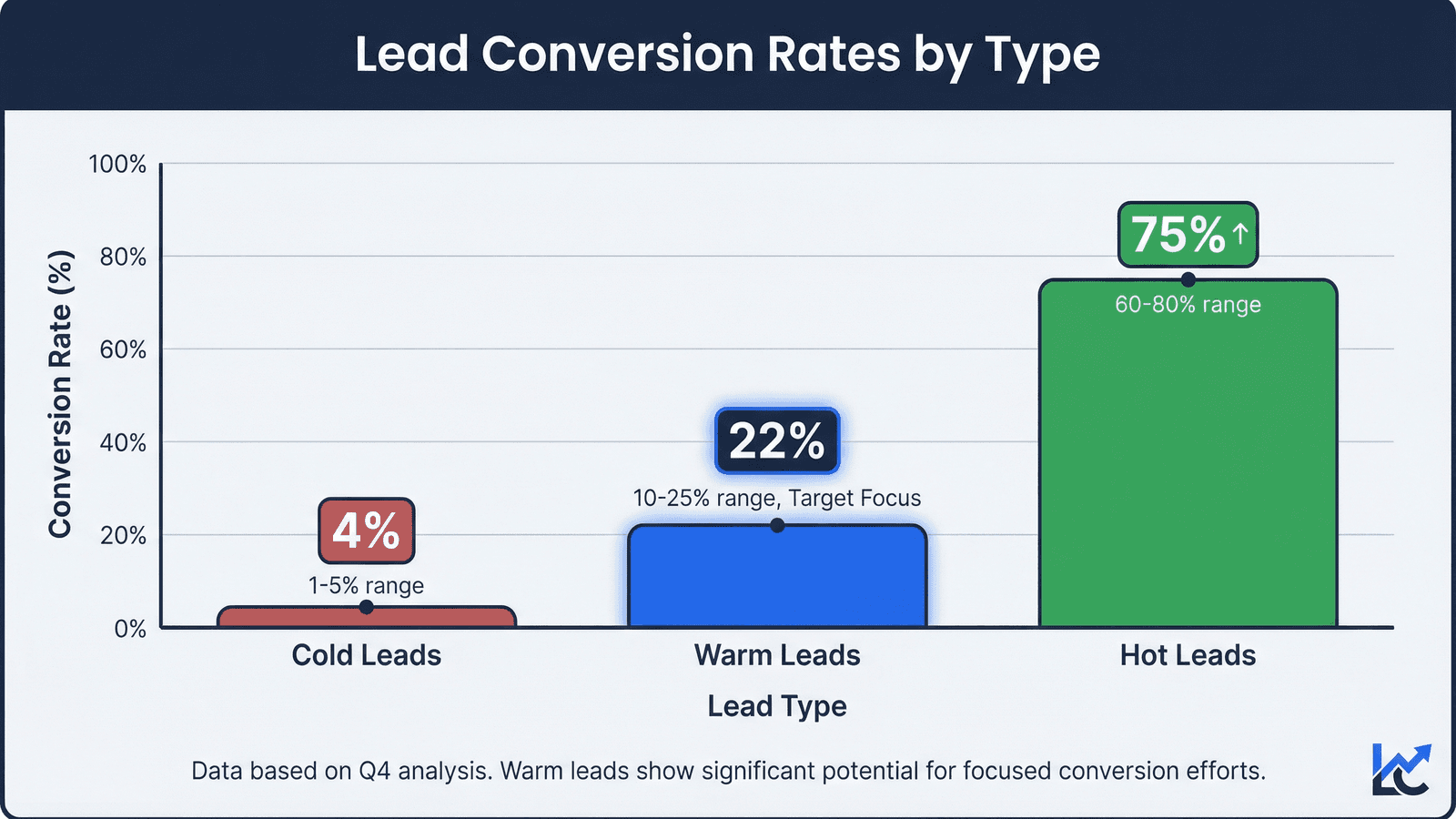
A good warm lead conversion rate is 10-25%. That's the range you should aim for. Compare that to cold leads at 1-5%, and hot leads at 60-80%.
Here's how the three lead types stack up:
| Lead Type | Conversion Rate | Typical Timeframe | Best Approach |
|---|---|---|---|
| Cold | 1-5% | 90-180 days | High volume, persistence |
| Warm | 10-25% | 30-60 days | Speed + personalization |
| Hot | 60-80% | 7-21 days | Immediate close focus |
Source: SPP.co / Martal Group, 2025
If you're hitting below 10%, something in your process is broken. The good news? It's fixable. The tips below will help you get there.
Speed: Why Timing Is Everything
Tip 1: Respond Within 5 Minutes
This one stat changed how I think about sales forever: responding within 5 minutes makes you 21x more likely to qualify a lead than waiting 30 minutes. Twenty-one times.
And yet? The average B2B response time is 42 hours. Not 42 minutes. Hours.
I've seen deals won and lost in the first 5 minutes. One startup I worked with doubled their close rate by moving from 2-hour response time to 15 minutes. No other changes. Just speed.
Speed to lead is the time between a prospect expressing interest and you making contact. When someone engages with your content, the context is fresh. They're thinking about the problem you solve right now. Wait too long, and that moment passes.
Five minutes feels aggressive. It is. But 78% of customers buy from the business that responds first. Not the best. The first.
Tip 2: Set Up Instant Lead Alerts
You can't respond in 5 minutes if you don't know a lead came in.
Set up notifications that ping you the moment someone engages. CRM alerts, Slack notifications, mobile push notifications. Whatever it takes. If you need help identifying warm leads through social engagement signals, start there first.
The goal is simple: never let a warm lead sit unnoticed. I've seen reps check their leads once a day. By the time they reach out, the prospect has already talked to three competitors.
Make it impossible to miss a new lead.
Tip 3: Prioritize by Intent Signal Strength
Not all warm leads are equally warm. Sound obvious? You'd think so. But most teams ignore this completely.
A comment shows more intent than a like. A webinar attendee who asked a question is warmer than someone who registered but didn't show. Someone who engaged multiple times is warmer than a one-time viewer.
Prioritize your hottest signals first. If you can only respond to 10 leads in the next hour, pick the ones showing the strongest buyer intent signals.
Whether you track engagement manually or use tools like Guffles to surface who's actively engaging with industry content, the principle is the same: prioritize the warmest signals first.
Persistence: The Fortune Is in Follow-Up
Tip 4: Plan for 8-12 Touchpoints
Here's a stat that should make you uncomfortable: 80% of sales require at least 5 follow-ups, yet 44% of sales reps give up after just one attempt.
One attempt. Then they move on.
Back when I was an SDR, I almost gave up on a lead after three no-responses. My manager pushed me to try two more times. That lead became our biggest deal that quarter.
I get it. Following up feels pushy. It feels annoying. (And yes, I've felt weird about it too.) But here's what I've learned: persistence is expected, not annoying. Buyers are busy. They miss emails. They forget. Your follow-up isn't a nuisance. It's a reminder.
Plan for 8-12 touchpoints with warm leads. Yes, really. That's the benchmark that works. (For more on this, see our guide on how many follow-up emails to send.)
Tip 5: Use Multi-Channel Follow-Up
Email alone won't cut it.
According to McKinsey's 2024 B2B Pulse Survey, B2B customers use an average of 10 interaction channels during their buying journey. Ten. If you're only emailing, you're missing 9 other places they might respond.
Mix it up. Email, phone, LinkedIn, even video. Each channel serves a different purpose. Email for details. Phone for urgency. LinkedIn for engagement and relationship building.
Belkins found that combining email, phone, and LinkedIn leads to 28% higher conversion rates. That's not a small bump. That's the difference between hitting quota and missing it.
Tip 6: Create a Structured Cadence
Random follow-ups don't work. You need a system.
Here's a simple cadence that works for warm leads:
- Day 1: Email + LinkedIn connection
- Day 3: Follow-up email with value add
- Day 7: Phone call
- Day 10: LinkedIn message
- Day 14: Email with social proof
- Day 21: Final value email
Space it out. Don't spam. But don't disappear either.
Here's the reality: managing 8-12 touchpoints across email, phone, and LinkedIn for dozens of warm leads is exhausting. I've seen reps spend more time updating spreadsheets than actually selling.
The good news? You don't need Apollo at $300/month or ZoomInfo at $500/month to solve this. Guffles does intent-based lead discovery for $79/month, pulling contact info for LinkedIn engagers so you can focus on the outreach, not the research.

Personalization: Make Every Touch Count
Tip 7: Reference Their Specific Engagement
I learned the hard way that "Hey, saw you liked my post" is not personalization. Real personalization is "Noticed you commented about struggling with X. We helped Y company solve exactly that."
Your warm leads became warm for a reason. They engaged with something specific. Reference it.
According to HubSpot, personalized CTAs increase conversion rates by 202%. Not 20%. Two hundred and two percent. That's the power of making someone feel seen.
Don't just acknowledge the engagement. Connect it to their pain point and your solution. That's what makes personalization work.
Tip 8: Use Relevant Case Studies
Generic social proof gets ignored. Specific social proof? That converts.
When you reach out, match your case study to their industry or role. A VP of Sales doesn't care about your marketing case study. They want to see what you did for another VP of Sales.
According to the 2025 B2B Buyer Behavior Report, 84% of B2B decision-makers begin their buying process with a referral. Social proof isn't optional. It's expected.
Build a library of case studies you can pull from. Match them to your lead's context.
Tip 9: Customize Your Value Proposition
Don't pitch the same thing to everyone.
An SDR cares about booking more meetings. A VP of Sales cares about pipeline velocity. A founder cares about revenue. Same product, different angle.
Connect your solution to their specific pain. This takes more work than blasting a template. But Forrester found that nurtured leads make 47% larger purchases. Personalization doesn't just improve conversion. It improves deal size.
Lead nurturing is building relationships with prospects through personalized communication and consistent follow-up until they are ready to buy. Our data shows that reaching out within 72 hours of engagement increases response rates by 5-7x compared to waiting a week. The engagement context is still fresh in their mind. That's what I call the 72-Hour Engagement Window. Miss it, and your personalization loses its punch.
Measurement: Track What Matters
Tip 10: Track Your Conversion Rate by Source
You can't improve what you don't measure. Classic advice, but it's true.
Not all warm lead sources convert the same. Webinar attendees might convert at 20%. LinkedIn engagers at 15%. Content downloaders at 10%. Without tracking, you're flying blind.
Companies that excel at lead nurturing generate 50% more sales-ready leads at 33% lower cost, according to Forrester. Measurement is how you figure out what's working.
Start simple. A spreadsheet works. Track which sources produce the best conversion rates, then double down on what works.
Common Mistakes That Kill Warm Lead Conversions
Quick hits on what NOT to do:
- Waiting too long: Average B2B response time is 42 hours. By then, they've talked to your competitors.
- Giving up after one or two attempts: 44% of reps quit after one try. Don't be that rep.
- Generic messaging: "Just checking in" emails get deleted. Reference their specific engagement.
- No clear next step: Every touch should have a purpose. What do you want them to do?
- Treating all warm leads the same: Some are warmer than others. Prioritize accordingly.
Avoid these, and honestly? You're already ahead of most sales teams.
Frequently Asked Questions
What is a warm lead?
A warm lead is a prospect who has shown interest through engagement like downloading content, attending a webinar, or interacting on social media. They know your brand but have not bought yet.
What is a good warm lead conversion rate?
A good warm lead conversion rate is 10-25%. Cold leads convert at 1-5%, while hot leads convert at 60-80%. Below 10% signals a process problem.
How long does it take to convert a warm lead?
Warm leads typically convert in 30-60 days versus 90-180 days for cold leads. Responding within 5 minutes can cut this timeline significantly.
Why do warm leads fail to convert?
Warm leads fail from slow response times (average 42 hours), poor follow-up (44% of reps quit after one try), generic messaging, and lack of personalization.
How many touchpoints to convert a warm lead?
Converting a warm lead requires 8-12 touchpoints across email, phone, and LinkedIn. 80% of sales need at least 5 follow-ups to close.
Quick Start: Convert Your Next Warm Lead
- Set up instant alerts so you respond within 5 minutes
- Plan your 8-12 touchpoint cadence across email, phone, and LinkedIn
- Reference their specific engagement in your first outreach
Start Converting More Warm Leads Today
Converting warm leads comes down to three things. Speed. Persistence. Personalization.
Respond in 5 minutes, not 42 hours. Follow up 8-12 times, not once. Personalize based on their actual engagement, not a template.
Do these three things consistently, and you'll hit that 10-25% conversion rate. Maybe higher.
But here's the catch: you need warm leads to apply these skills to. If you're still relying on cold lists, you're fighting with one hand tied behind your back.
Guffles helps you find people who are already engaging with content in your space. The warmest leads available. Start with $150 in wallet credit at guffles.com and see how many warm leads you've been missing.
Ready to Find Warm Leads?
Guffles surfaces LinkedIn engagers who are already interested in your space. Intent-based leads at $79/month with $150 in credits to start.
7-day free trial • Cancel anytime