
You write what feels like the perfect first message. Friendly, personalized, not too salesy. You hit send. And then... nothing. Sound familiar? I've been there more times than I can count. In my 8 years of B2B sales, I've sent thousands of LinkedIn first messages after connecting. Some got replies. Most didn't. And after analyzing what worked versus what flopped, I discovered something that changed everything: the problem usually isn't WHAT you say. It's WHO you're saying it to.
A LinkedIn first message after connecting is the initial direct message you send within 24-48 hours of someone accepting your connection request. The goal is building rapport, not pitching.
Why Most First Messages Fail (And It's Not What You Think)
Here's the thing most LinkedIn gurus won't tell you: your template isn't the problem.
When I was running demand gen at my last startup, I tested every template format imaginable. The clever ones. The direct ones. The ones that "worked for everyone else." Results were all over the place. Some templates got 15% response rates. The exact same template sent to different connections got 2%.
What changed? The people I was messaging. And honestly, how I was connecting with them in the first place. (If you're still struggling with getting people to accept, check out our guide on LinkedIn connection request templates that actually work.)
Belkins' 2025 study of 20+ million outreach attempts backs this up. Messages to first-degree connections achieve a 16.86% response rate compared to 10.3% for general LinkedIn DMs. That's 64% higher just based on connection status. Same message. Different audience. Wildly different results.
And it gets more interesting. Expandi's 2025 analysis of 70,000+ campaigns found personalized messages achieve a 9.36% reply rate versus just 5.44% for generic templates. That's a 72% lift.
So yes, personalization matters. But here's what nobody talks about: personalization with the right person matters way more.
Think about it. You connect with random ICP matches who've never heard of you. Never engaged with anything in your space. Your first message is basically cold outreach wearing a warm-outreach costume. Know the feeling? You craft something thoughtful, hit send, and... crickets. The template doesn't save you when the recipient has zero context for why you're in their inbox.
Who you message matters more than what you say: first-degree connections with prior context achieve 16.86% response rates, 64% higher than average LinkedIn DMs.
The 72-Hour Engagement Window: When Timing Becomes Everything
Timing isn't just a nice-to-have. It's everything.
I learned this the hard way. Early in my career, I'd connect with people and then... wait. I told myself I was "giving them space" or "waiting for the right moment." What I was really doing? Letting the context fade. I once waited a full week to message a VP who'd accepted my request. By then, she had no idea who I was. Lesson learned.
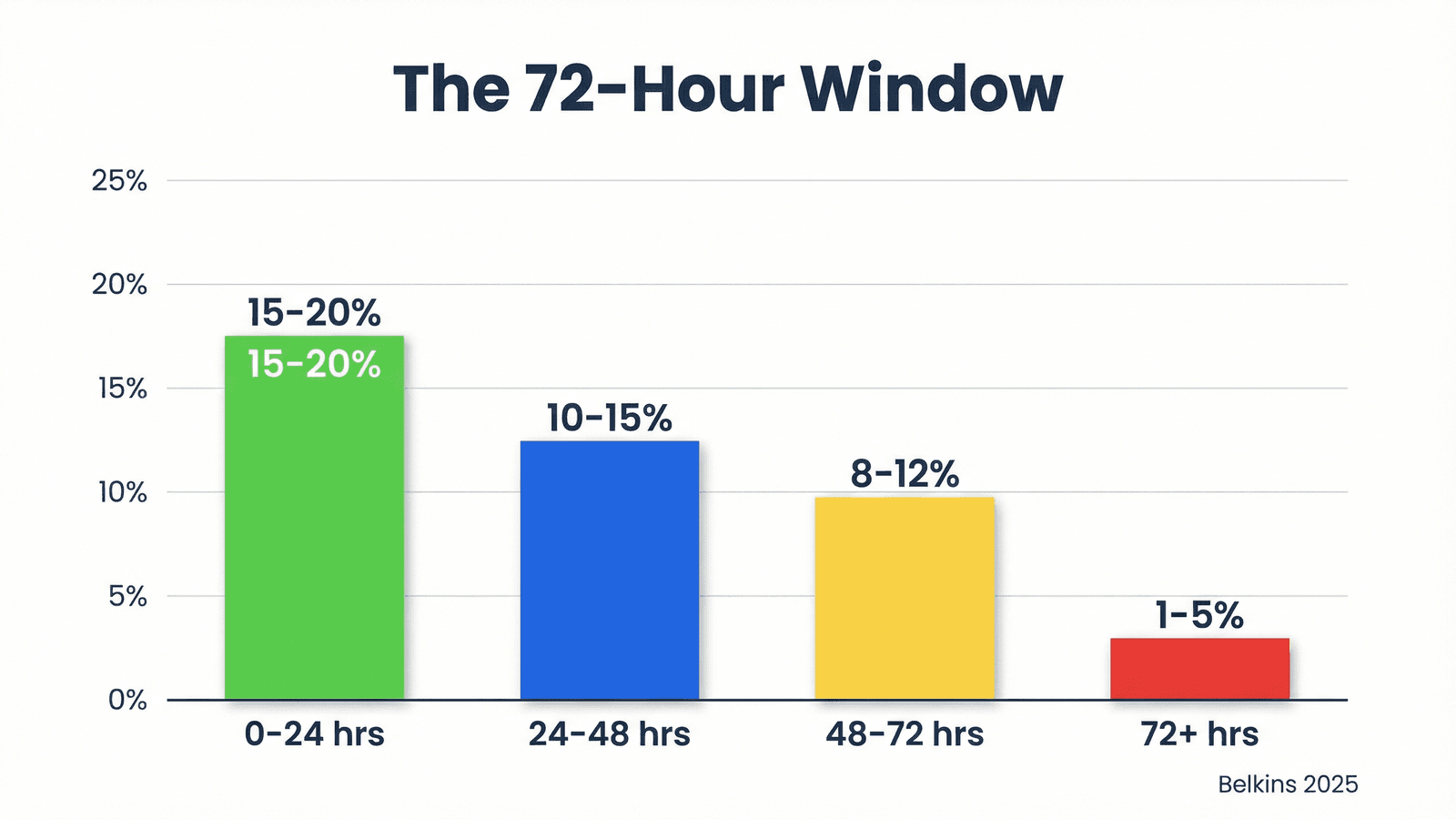
The 72-Hour Engagement Window is the optimal timeframe for your first message after a connection accepts. Response rates hit 15-20% within 24 hours but drop to cold levels (1-5%) after 72 hours.
The data backs this up. Response rates decay fast after someone accepts your connection:
| Time Since Connection | Expected Response Rate | Status |
|---|---|---|
| 0-24 hours | 15-20% | Optimal |
| 24-48 hours | 10-15% | Good |
| 48-72 hours | 8-12% | Declining |
| 72+ hours | 1-5% | Cold |
Source: Belkins LinkedIn Outreach Study 2025
Why the steep drop? After 72 hours, they've forgotten why they accepted. The context is gone. Your message becomes just another notification from a stranger. And strangers don't get replies.
Here's something that changed my game. Belkins' research shows campaigns combining a direct message with a profile visit achieve 11.87% reply rates, more than double the 4.88% from messages alone. That's 143% higher. So before you message, visit their profile. They'll see the notification and remember who you are. Takes 5 seconds. Doubles your chances.
And the best day to send? Belkins' data shows Tuesday has the highest reply rate at 6.90%, followed by Monday. Weekends? Worst performance. (I used to batch my outreach on Sunday nights. Terrible idea.)
But here's what matters most. Before you even think about your first message, consider who you're connecting with. Tools like Guffles help you find warm leads through social engagement signals. When someone's already shown interest in your space, your first message isn't truly "cold" at all. That's the real advantage.
Message within 24-48 hours for 15-20% response rates. After 72 hours, rates drop to 1-5% because the connection context fades from memory.
7 LinkedIn First Message Templates That Actually Get Replies
Before we get into the templates, one number you need to know: LinkedIn data shows shorter messages (under 400 characters) get 22% more replies than longer ones. So I've kept every template under that limit. Short. Scannable. Mobile-friendly.
Template 1: The Grateful Opener
Best for: When you don't have a specific angle
Hey [Name], thanks for connecting! I noticed you're [specific observation]. How are you finding [relevant topic]?
The key here? That specific observation. Don't just say "thanks for connecting." Add something real. "I noticed you just moved into a product role at Stripe" or "I saw you've been in fintech sales for a few years." Make it clear you actually looked at their profile. Takes 30 seconds. Worth it.
Template 2: The Content Reference
Best for: When they actively post or comment
Hey [Name], your post about [topic] really stuck with me - especially [specific point]. I've been thinking about [related angle]. Have you found [question related to their content]?
This is my highest-converting template. Hands down. Why? Because it shows you actually pay attention. You're not just harvesting connections. (And yes, I've made this mistake too. Sent generic messages to people whose content I should've referenced. Embarrassing in hindsight.)
Template 3: The Shared Interest
Best for: Mutual connections or shared background
Hey [Name], noticed we both [shared connection/background]. How's [relevant current situation] going for you?
Same school, same previous company, same industry transition. These create instant rapport. I once got a 10-message thread going just because we both worked at the same company five years apart. People love talking about shared experiences.
Template 4: The Direct Value
Best for: When you genuinely have something useful
Hey [Name], I came across [resource/insight] and immediately thought of your work in [their area]. Figured it might be useful. No agenda - just thought you'd find it interesting.
The "no agenda" part is important. And you have to mean it. If you follow up with a pitch, you've burned the trust. I've seen reps do this. Burned bridge. Done.
Template 5: The Networking Play
Best for: Genuine relationship-building
Hey [Name], I've been following your journey in [their space] - really interesting path. Would love to hear how you got into [specific aspect] sometime.
Pure curiosity. No hidden agenda. Sometimes that's exactly what the situation calls for. Not every connection needs to become a customer.
Template 6: The Recruiter Special
Best for: Recruiter-to-candidate outreach
Hey [Name], your background in [specific skill] caught my attention. I'm working on a [role type] opportunity at [company type] that might align. Would you be open to a quick chat about what you're looking for in your next move?
Worth noting: Belkins' data shows HR and talent acquisition professionals respond at the highest rate: 12.08%. They're used to this kind of outreach. It's literally their job.
Template 7: The Sales Intro
Best for: Potential customers (but don't pitch yet!)
Hey [Name], noticed [specific observation about their company/role]. I work with similar [companies/teams] on [general area], but honestly I'm curious - how are you currently handling [relevant challenge]?
Notice what's NOT in this template? A pitch. You're opening a conversation, not closing a deal. Real talk: I've watched so many salespeople blow their shot by pitching in message one. Seen it happen a hundred times. Don't do it. Build rapport first. The sale comes later.
Keep messages under 400 characters for 22% more replies. The Content Reference template (mentioning their recent post) converts best because it proves you pay attention.

The Personalization Problem (And How to Scale It)
Here's the tension every sales professional faces: manual personalization research takes 10+ minutes per connection. That doesn't scale. Not when you need to message 50 people a day.
But generic templates get 5.44% response rates while personalized ones get 9.36%. You can't ignore a 72% difference. That's the gap between hitting quota and missing it.
A personalized LinkedIn message references specific details from the recipient's profile, recent posts, or shared connections. According to Expandi's 2025 data, personalized messages get 72% higher response rates than generic templates.
I tried everything. Seriously. Spreadsheets. Chrome extensions. Hiring a VA to research prospects. AI tools help a bit. Expandi's 2025 data shows AI-assisted first messages achieve 4.19% response rates compared to 2.60% without AI assistance. That's 61% higher. But AI still needs triggers. It needs something specific to personalize around. You can't just say "write me a personalized message" with no context.
So here's the scaling problem: you can spend 10 minutes researching each connection to find something to personalize, or you can skip it and send generic messages. Neither works well. Been there. Tried both.
Guffles takes a different approach. At $79/month (versus $300+ for enterprise tools like Apollo), it surfaces people who've already engaged with specific LinkedIn content. That engagement IS your personalization trigger. Already built in.
Think about it: "I noticed you commented on Sarah's post about SDR burnout. I've been thinking about the same thing..." That's not creepy. That's relevant. And you didn't spend 10 minutes finding it. The engagement signal was already there waiting for you. (Want to learn more about what makes someone ready to engage? Check out our breakdown of buyer intent signals that show prospects are ready.)
Multi-step sequences help too. Your first message doesn't have to do all the work. Belkins' research shows sequences with 2-3 strategic follow-ups can boost response rates to 20-30%. But that first message? It sets the tone for everything that comes after.
Manual research takes 10+ minutes per connection and doesn't scale. Engagement-based targeting provides built-in personalization triggers, boosting response rates from 5.44% to 9.36%.
Quick Best Practices (Things That Actually Move the Needle)
I've tested a lot of tactics over the years. Most don't move the needle. These seven do:
1. Keep it under 400 characters - That's about 3-4 sentences. LinkedIn data shows 22% more replies for shorter messages. People are busy. Respect that.
2. Visit their profile before messaging - Campaigns combining profile visits with messages get 11.87% reply rates versus 4.88% for messages alone. That's a 143% improvement. Five seconds of work. Doubles your odds.
3. Send on Tuesday or Monday - Belkins' data shows Tuesday at 6.90% reply rate leads all days. Avoid weekends. Seriously. I used to think Sundays were great for prep. Nope. Dead zone.
4. Never pitch in message one - I know, you're excited about your product. I get it. But pitching in your first message kills engagement. Wait 2-3 exchanges. Build the relationship first.
5. End with a question - Not a statement. Questions invite responses. Obvious? Yes. But I still see people ending with "Let me know if you're interested." That's not a question. That's a dead end.
6. Use contractions and conversational tone - "I'm curious about..." beats "I am curious about..." You're having a conversation, not writing a press release. Sound like yourself.
7. One clear ask, maximum - Don't ask for a call AND ask for their thoughts AND ask them to check out your content. Pick one thing. More asks = fewer replies. For more tactical advice, see our 15 LinkedIn lead generation tips.
Combining a profile visit with your message gets 11.87% reply rates versus 4.88% for messages alone. That's a 143% improvement with one simple step.
5-Step First Message Framework
- Thank them briefly for connecting
- Reference something specific from their profile
- Mention a shared interest or mutual connection
- Add a personalized compliment or observation
- End with an open-ended question
You don't need all five in every message. But having a framework keeps you from rambling.
Frequently Asked Questions
What should I say in my first LinkedIn message after connecting?
Thank them briefly, reference something specific from their profile, and end with an open-ended question. Keep it under 400 characters. Skip the sales pitch entirely.
How soon should you message after a LinkedIn connection is accepted?
Within 24-48 hours. Response rates hit 15-20% in the first 24 hours but drop to 1-5% after 72 hours. The connection context fades quickly.
Should you thank someone for accepting your LinkedIn connection?
Yes, but keep it brief and immediately add value. A thank you plus a personalized observation and question works better than generic 'thanks for connecting' messages.
How do you start a conversation on LinkedIn after connecting?
Reference their recent post or shared interest. Ask an open-ended question. Personalized messages get 72% higher response rates than generic ones.
What is a good LinkedIn first message to a recruiter?
Mention the role or industry you want, highlight relevant experience, and ask about opportunities in their pipeline. Recruiters respond at 12.08%, the highest of any role.
How long should your LinkedIn first message be?
Under 400 characters (2-4 sentences). LinkedIn data shows shorter messages get 22% more replies. Keep it mobile-friendly.
Is it okay to sell in your first LinkedIn message?
No. Pitching in message one kills engagement. Wait at least 2-3 exchanges before mentioning your product. Your first message opens a conversation, not a deal.
Templates Are Step Two
Look, the templates in this article will help you start better conversations. I've used every one of them myself. Some worked great. Some bombed. The difference was almost always the person on the other end.
That's the thing I keep coming back to after 8 years and thousands of LinkedIn messages: the biggest improvement comes from connecting with the right people in the first place. Those who've already engaged with content in your space. Those who have context before you ever reach out. And once they reply? You'll want to know how to convert those warm leads into customers.
That's not a template problem. That's a connection problem. And once you fix the connection problem, the templates actually work.
Four key takeaways:
- WHO you message matters more than WHAT you say - Start with the right connections
- The 72-hour window is real - Message within 24-48 hours
- Use templates as frameworks, not scripts - Personalize the trigger points
- Engagement-based connections provide built-in personalization - They've already raised their hand
If you want to try the engagement-based approach, Guffles offers $150 in wallet credits to get started at guffles.com. Find warm connections, then use these templates. The combination is what moves the needle. I wish I'd figured this out earlier.
Guffles helps you find people who've already engaged with content in your industry. Get $150 in wallet credits to discover your first warm leads and see why engagement-based outreach converts better.
Turn LinkedIn Engagement Into Pipeline
Stop guessing who to connect with. Find people already engaging with content in your space and send first messages that have built-in context.
7-day free trial • Cancel anytime