
ZoomInfo just sent you the renewal quote. You're staring at $15,000+ for another year of contact data. Sound familiar?
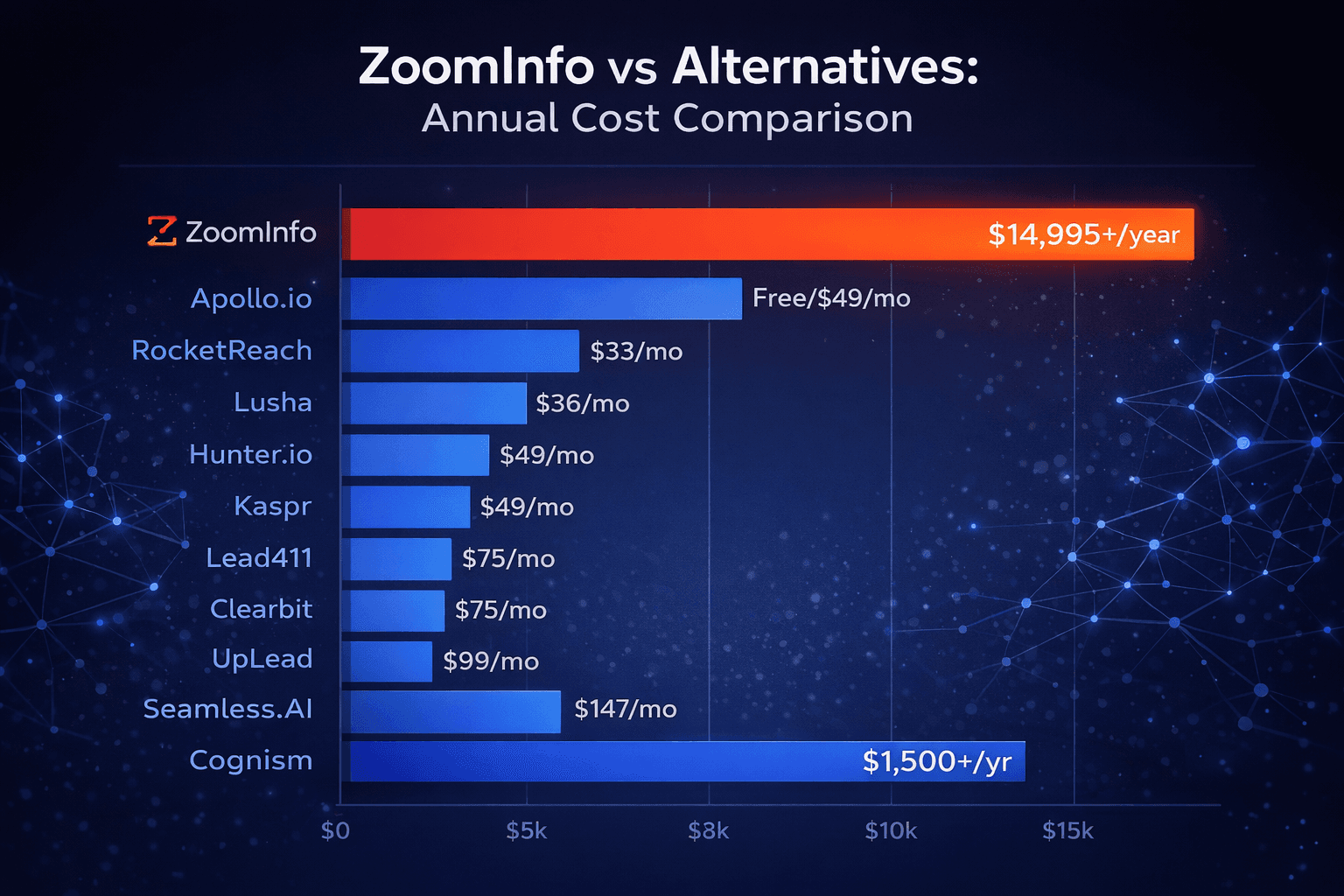
I've been in this exact spot. After 8 years in B2B sales, I've watched ZoomInfo grow from a useful tool to an enterprise behemoth that costs more than some people's salaries. (And yes, I've paid those invoices. Painfully.) According to Cognism's 2026 pricing analysis, ZoomInfo runs between $14,995 and over $100,000 annually depending on your team size and features.
Look, ZoomInfo earned 133 No. 1 rankings in G2's Summer 2025 Reports for a reason. It's a solid product. But solid doesn't mean right for everyone. Especially when you're a startup or mid-size team that can't justify enterprise pricing for features you'll never use.
The good news? You have options. Real ones. This isn't another competitor article where I pretend some lesser-known tool is secretly better than everything else. I'm going to walk you through 10 legitimate ZoomInfo alternatives, explain why all databases face the same core challenge, and introduce an approach most comparison articles skip entirely.
1) The Real Question: Database vs. Intent
Before I dump a comparison table on you, let's talk about what most "ZoomInfo alternatives" articles get wrong.
They all list databases. Apollo, UpLead, Lead411, Cognism. Same category, every time. Static contact databases with varying accuracy claims and credit systems. That's it.
But here's the thing. There's another approach entirely: intent-based discovery. Instead of buying database access and hoping your cold emails land, you can find prospects who are already showing interest through their online behavior.
This article covers both. I'll give you the honest rundown on 10 database alternatives (because that's what you came here for). But I'll also show you why "cheaper database" might not solve the problem you're actually facing.
2) Quick Comparison: 10 ZoomInfo Alternatives
Here's what you're working with. I've tested most of these over the years, and I'll be straight with you about what each one actually delivers. No fluff. No vendor spin.
| Tool | Starting Price | Best For | Key Limitation |
|---|---|---|---|
| Apollo.io | Free/$49/mo | All-in-one prospecting | Credits expire monthly |
| Lead411 | $75/user/mo | Unlimited data | Smaller database |
| UpLead | $99/mo | Data accuracy | No built-in outreach |
| Lusha | $36/user/mo | LinkedIn lookups | Limited credits |
| Cognism | Custom ($1,500+/yr) | European markets | No public pricing |
| Kaspr | Free/$49/mo | LinkedIn prospecting | Best for EU only |
| RocketReach | $33/mo | Simple lookups | No intent data |
| Seamless.AI | $147/mo | AI-powered search | 5-user minimum on Pro |
| Clearbit | $75/mo (HubSpot) | CRM enrichment | Requires HubSpot |
| Hunter.io | $49/mo | Email finding | Email only, no phones |
Pricing verified from vendor websites, January 2026
The Breakdown
Apollo.io is your best free option. 275M+ contacts, built-in email sequences, and you can start without a credit card. The catch? Credits expire monthly, and data quality can be hit-or-miss. But for the price (free to $119/user), it's hard to beat as a starting point. If you're comparing tools in this category, check out our Apollo alternatives guide for more depth.
Lead411 takes the opposite approach. Unlimited data at $75/user/month. Smaller database than ZoomInfo, sure, but zero credit anxiety. I've talked to teams who switched just to stop stressing about export limits. That peace of mind? Underrated.
UpLead leads with a 95% accuracy guarantee. Real-time email verification at $99/month. If data quality keeps you up at night, this one deserves a look. Just know there's no built-in outreach. You'll need another tool for sequences.
Lusha is the budget play at $36/user. Great for individual reps doing LinkedIn lookups. Limited credits make it tough for teams, but for solo prospectors it's a solid entry point. We covered more options in our Lusha alternatives comparison.
Cognism dominates European markets with phone-verified mobiles. But there's no public pricing, so you'll need a sales call to get started. Expect $1,500-25,000/year depending on team size. Worth it if EU data quality matters to your business.
Kaspr is LinkedIn-focused with unlimited B2B emails on the free tier. The platform shines for European contacts and GDPR-compliant workflows. US teams might find the database thinner than expected.
RocketReach keeps it simple at $33/month. Bulk lookups, API access, no fluff. But no intent data and no sequences means you're just getting contact info. Nothing else.
Seamless.AI promises real-time AI-powered search. The catch? $147/month starting price, credits expire daily, and Pro plans require 5 users minimum. I've heard mixed reviews on data quality. Test before you commit.
Clearbit (now Breeze Intelligence) is excellent if you're already in HubSpot. Native integration, real-time enrichment, solid data. But it requires a HubSpot subscription and the free tools are gone.
Hunter.io does one thing well: email finding and verification. $49/month, transparent pricing, API-friendly. No phone numbers though. Email-only.
All ten tools above compete on the same playing field: static databases with varying accuracy claims and credit systems. But there's another approach gaining traction. Intent-based discovery tools like Guffles find prospects from real-time engagement signals rather than demographic data. Different strategy, different outcome.
I'll dig into that approach later. First, let's talk about the elephant in the room.
3) The Problem All B2B Data Providers Share
Here's something the vendor comparison pages won't tell you: every database faces the same enemy. Data decay.
According to Landbase's 2025 research, B2B contact data decays between 22.5% and 70.3% annually. Email decay hits 3.6% per month. People change jobs, companies restructure, emails stop working. It doesn't matter if you're using ZoomInfo, Apollo, or the most accurate database on the planet. Static data goes stale. Always.
Vendors claim 95% accuracy. But here's what I've seen in practice: user reviews consistently report 15-20% email bounce rates. That gap between promise and reality? It's real. And it's frustrating when you're paying premium prices.
Even when the data is accurate, you're still cold outreaching. Instantly's 2026 Cold Email Benchmark Report shows average reply rates of 3.43%. Down from 8.5% in 2019. The contacts might be right. The timing isn't. If you're curious why response rates have dropped so much, our cold email response breakdown digs into the data.
Only 23.6% of B2B marketers even verify email lists before campaigns, according to Landbase. So most teams are paying for data that's decaying, sending to emails that bounce, and wondering why response rates keep dropping.
This isn't a ZoomInfo problem. It's a database problem.

4) Why Intent-Based Tools Are Different
Here's where I get to share what's actually working for the teams I talk to.
Intent-based prospecting flips the script. Instead of starting with a database and hoping someone responds, you find people who are already showing interest. Engagement signals. Comments on competitor posts. Likes on industry content. Real behavior that indicates someone's thinking about problems you solve.
Martal's 2026 LinkedIn statistics show message response rates of 10.3% versus 5.1% for cold email. That's roughly double. And Sopro reports that intent-based warm calls result in 8% booked meetings. That's 4x more effective than cold calling.
Companies using intent data close deals 20% faster, according to SpanGlobal Services. It's not magic. It's timing. You're reaching people when they're actually thinking about the problem.
Real talk: the Social Selling Stack I've seen work best starts with discovery. Find who's already interested. Don't start with a cold database and hope for the best. We've written more about this in our warm vs cold outreach data breakdown.
This is where intent-based tools take a different angle. Guffles ($79/month flat) doesn't compete on database size. It extracts prospects from LinkedIn post engagement in real-time. Someone who commented on a competitor's post yesterday? That's a warm signal you can act on today.
No decay because there's no static database. Just live engagement data. You paste a LinkedIn post URL, Guffles extracts everyone who engaged, and you filter by your ICP criteria. Simple as that. The contacts are fresh because the engagement just happened.
Compare that to Apollo ($49-119/user) or ZoomInfo ($14,995+/year). They're giving you access to contacts who might be interested. Intent tools show you who's already raising their hand.
5) How to Choose the Right ZoomInfo Alternative
I'm not going to give you the wishy-washy "it depends on your needs" non-answer. Here's what I'd actually recommend based on your situation.
Budget under $50/month? Go with Apollo.io's free tier or Hunter.io Starter. Accept the credit limitations, verify emails manually with a tool like NeverBounce, and make it work. Plenty of teams start here and do fine. Check our B2B sales tools under $100 guide for more budget options.
Need unlimited data without credit anxiety? Lead411 at $75/user is the move. The database is smaller than ZoomInfo, but you'll stop stressing about export limits. Sometimes peace of mind matters more than database size.
Targeting European markets? Cognism for phone-verified mobiles, Kaspr for LinkedIn data. Both have GDPR compliance built in, which matters if you're reaching EU contacts.
Already deep in HubSpot? Clearbit (Breeze Intelligence) is native integration. Credit-based but works smoothly with your existing CRM.
Want to skip the database game entirely? Try intent-based discovery. Find prospects showing engagement signals, then use a cheaper enrichment tool to get contact details. Different workflow, often better results. Our intent data providers comparison covers more options here.
Have enterprise needs and budget? Honestly, ZoomInfo might still be the right call. I know, weird thing to say in a "ZoomInfo alternatives" article. But the integrations, intent data depth, and scale matter for teams with 10+ reps doing high-volume outreach. Know your situation.
The question isn't "Which database has the most contacts?" It's "Which contacts are actually ready to buy?"
Frequently Asked Questions
What is the best free alternative to ZoomInfo?
Apollo.io is the best free ZoomInfo alternative. It offers unlimited email credits and access to 275M+ contacts with no credit card required.
Why is ZoomInfo so expensive?
ZoomInfo's pricing reflects its 321M contact database, intent data features, and enterprise integrations. They target large sales teams who justify the cost through volume.
Is ZoomInfo worth the price?
For enterprise teams with 10+ reps, yes. For small teams and startups, alternatives at $49-199/month offer 90% of the functionality at 10% of the price.
Can you cancel ZoomInfo anytime?
No. ZoomInfo requires annual contracts with auto-renewal. Cancellation requests must be submitted 30-60 days before renewal date.
What is the cheapest ZoomInfo alternative?
RocketReach at $33/month is the cheapest paid option. Apollo.io offers the best free tier for those who want to start without paying.
The Social Selling Stack Approach
- Find prospects who are already showing buying signals through engagement
- Reach out while the intent is fresh (not from a stale database)
- Use cheaper enrichment tools to get contact details after identifying warm leads
You've got real options beyond ZoomInfo's enterprise pricing. The database alternatives are solid. Apollo for free/budget. Lead411 for unlimited data. UpLead for accuracy. Cognism for Europe. Pick based on your actual workflow, not feature checklists.
But here's what I keep coming back to. The bigger decision isn't which database to choose. It's whether you need a database at all, or whether you'd be better off finding prospects who are already showing buying signals.
The teams I work with who've made the switch report higher response rates, shorter sales cycles, and less time wasted on contacts who were never going to respond anyway. That last one? Probably the biggest win.
Next Steps
If the intent-based approach sounds interesting, Guffles offers $150 in credits to test it with your actual ICP. No annual contract, no credit expiration anxiety. Just paste some LinkedIn posts and see who's engaging.
Or start manual. Track a few competitor posts and reach out to engagers yourself. Either way, you're prospecting warmer than any database can deliver.
The question isn't which database has the most contacts. It's whether you need a database at all, or whether intent-based prospecting would deliver better results for your team.
Find Prospects Already Interested in What You Sell
Stop paying enterprise prices for stale data. Try intent-based lead discovery with $150 in free credits.
7-day free trial • Cancel anytime